• Home
  • About
    • Ocean Conservation
  • Mermaid Art
    • Artists
    • Mermaid Poems
    • Pictures
      • Public Paintings and Murals
    • Statues
      • Public Mermaid Statues & Sculptures
      • Private Mermaid Statues & Sculptures
      • Mermaid statues and mermaid sculptures for sale
  • Shop
    • Mermaid Jewelry
    • Mermaid Tails
    • Mermaid Books
  • Contact
  • Blog

Spain  ·  1987

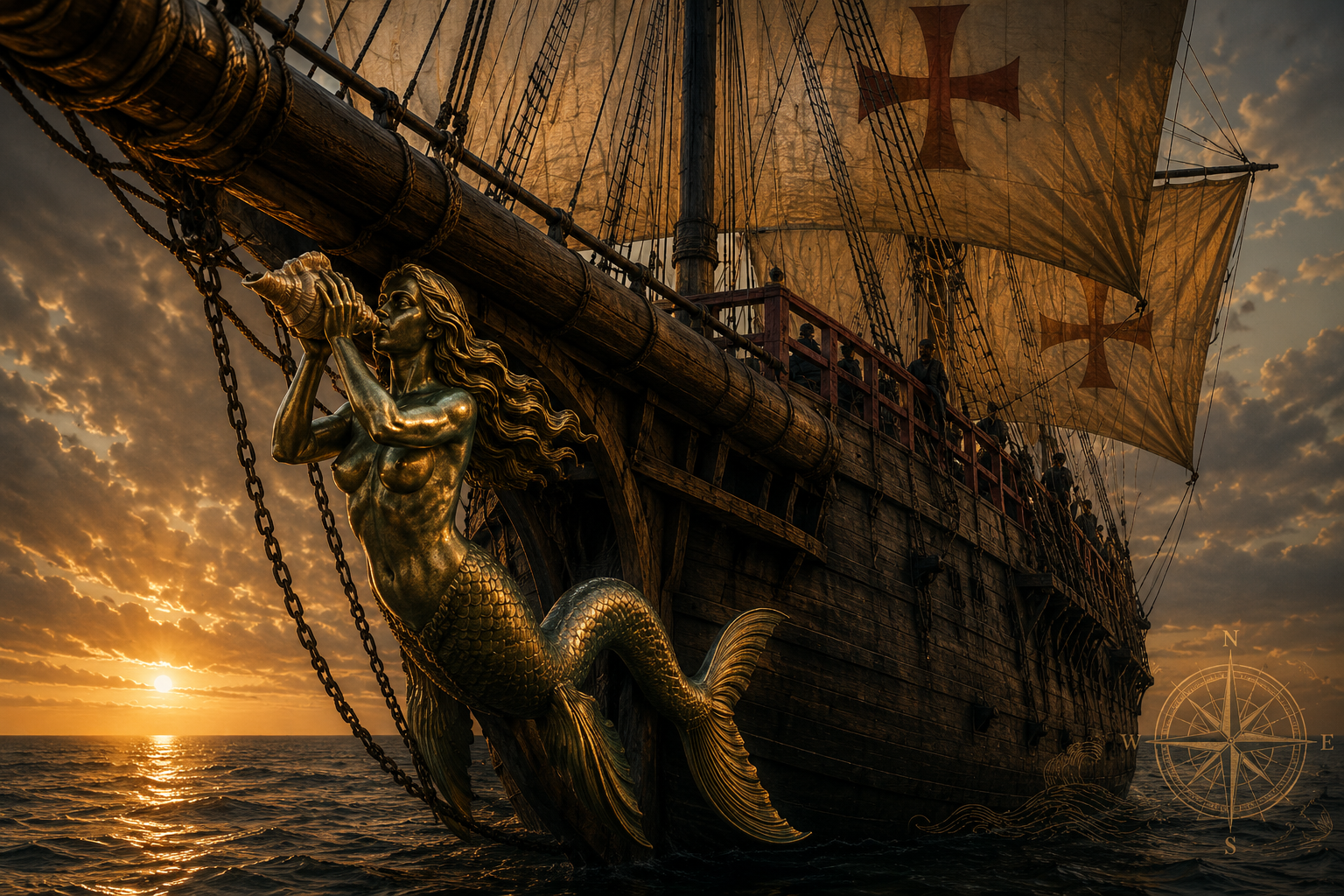
On the northern coast of Spain, where Atlantic winds sweep across cliffs and royal gardens overlook the sea, a bronze mermaid watches silently over the Bay of Santander. She is known as the Sirena Magdalena.
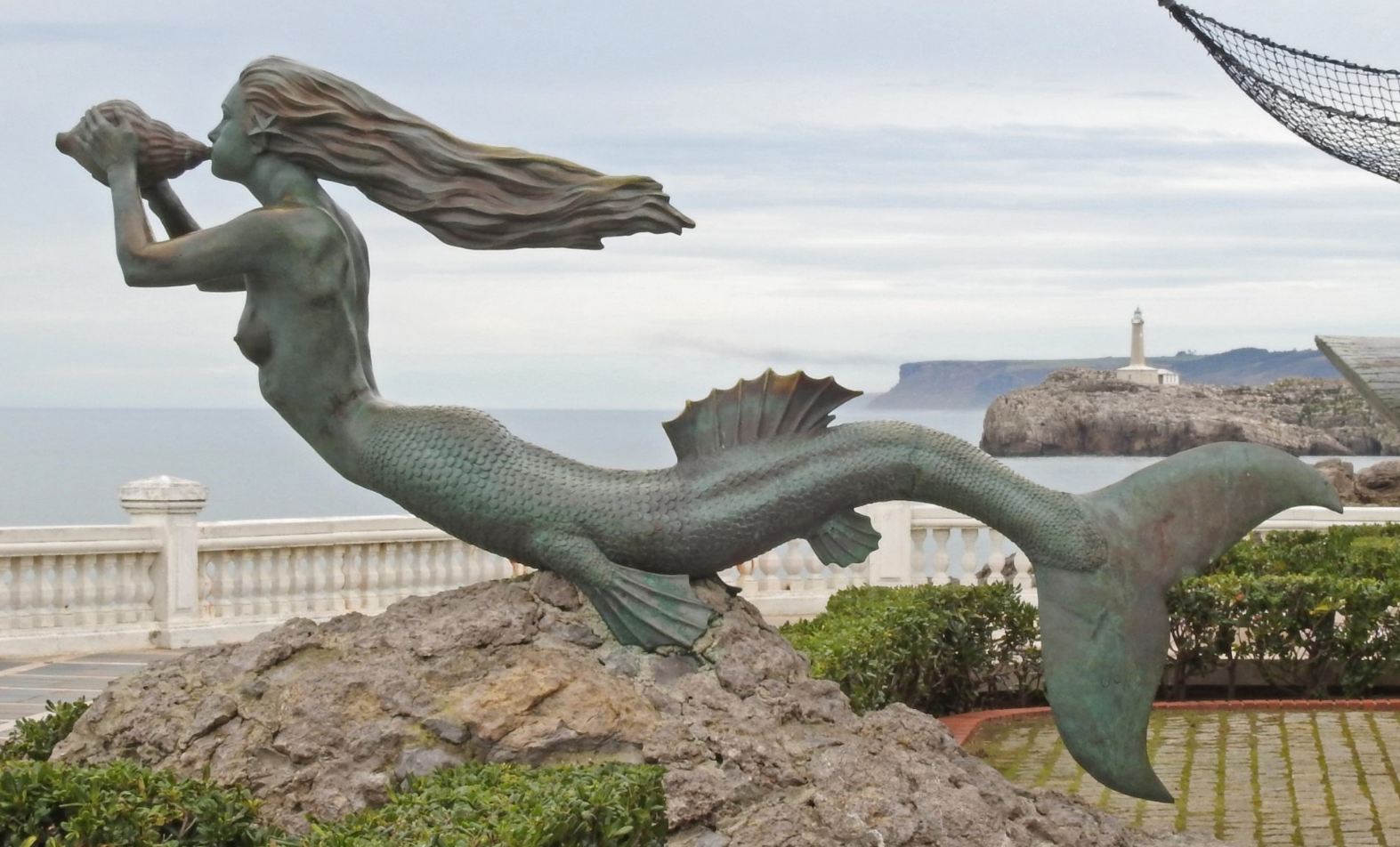
Sirena Magdalena, Santander
Sirena Magdalena, Magdalena Peninsula, Santander. Bronze, completed 1987.

At first glance, she appears to be simply another beautiful seaside sculpture. But her story stretches much farther — across oceans, centuries, and some of the earliest voyages into the unknown.

The Sirena Magdalena was sculpted in Mexico between 1980 and 1987, commissioned by the Spanish maritime adventurer Vital Alsar Ramírez as the figurehead of the Marigalante — a full-scale replica of the Santa María, the ship Christopher Columbus sailed on his first crossing in 1492. In 1992, the Marigalante set sail from Veracruz to Spain to mark the 500th anniversary of that voyage. At her prow was the mermaid.

For centuries, sailors carved figures of women, spirits, and sea creatures onto the bows of ships. Figureheads were believed to protect vessels, calm dangerous waters, and guide crews safely through storms and darkness. Mermaids — suspended between beauty and mystery — became some of the most powerful symbols of the sea itself.

Columbus himself claimed to have seen mermaids. His log for January 9th, 1493 — preserved through Bartolomé de las Casas — records three “mermaids” rising from the sea off Hispaniola, though he noted with some disappointment that they were “not so beautiful as they are depicted.”

— Columbus’s log, January 9th, 1493

There is one more layer that makes her especially fitting for Santander. The original Santa María belonged to Juan de la Cosa — explorer, navigator, and cartographer — who later drew one of the earliest surviving maps of the world to include the Americas. The mermaid is, in a way, an intersection — of myth, navigation, exploration, and imagination.

Today she presides over the Magdalena Peninsula, surrounded by ocean paths, beaches, old maritime traditions, and the endless Atlantic horizon. It feels like the kind of place where old legends still linger in the salt air.

Where to Find Her

The Sirena Magdalena can be found in Santander, on Spain’s rugged Cantabrian coast, near the Palacio de la Magdalena — a former royal summer residence overlooking the sea. The peninsula itself is extraordinary: part windswept Atlantic landscape, part maritime dreamscape. Walking paths curve above rocky cliffs, small beaches hide below pine-covered slopes, and historic ships face outward toward the ocean as if still waiting for departure.

Read the Full Entry →

From the Studio

Art print inspired by the Sirena Magdalena
Imagining the bronze figurehead crossing the Atlantic beneath storm-lit skies and fading lantern light.

This article first appeared in Issue 01 of The Mermaid Dispatch, the weekly newsletter of Mermaids of Earth. Subscribe here to receive each new issue on Sunday morning.
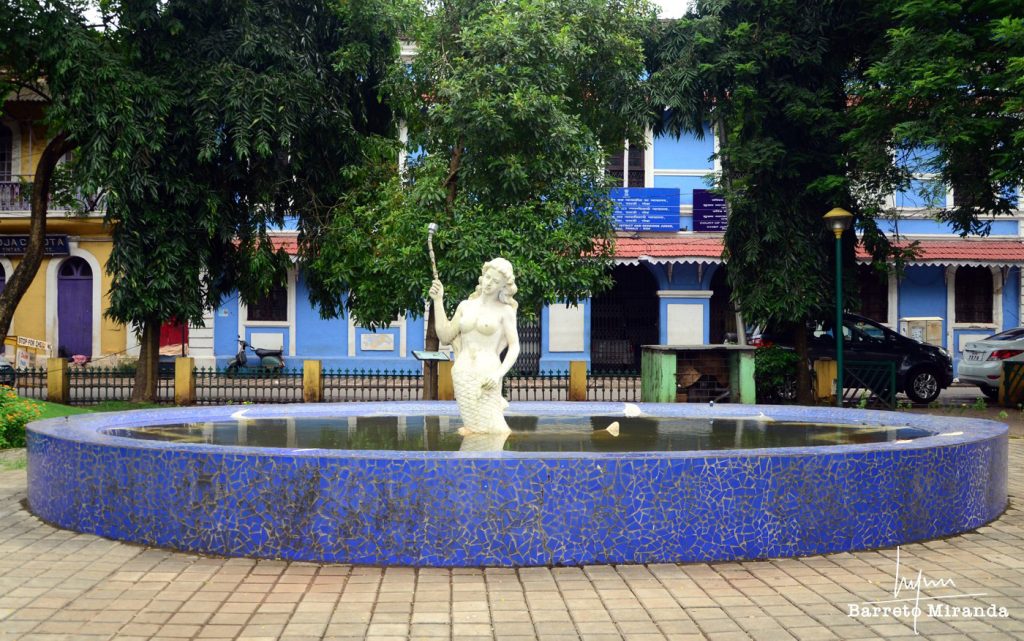
In the Panjim area of the Goa Province on the west coast of India is a mermaid fountain dating back to probably 1952. Vandalized and painted numerous times, the mermaid was restored in 2019. More images of this fountain and mermaid are being sought for this page dedicated to this mermaid.

Panjim Mermaid Fountain

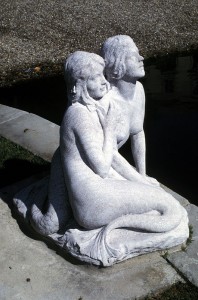
Cleveland Mermaids
Fidardo Landi’s mermaids

This sculpture of two mermaids was created by Fidardo Landi, an italian sculptor who came to America in 1900. Landi became a professor of sculpture at the Academy of Fine Arts in Carrera Italy at the age of 20, and came to America when he received a commission for a sculpture there.

While Landi passed away before finishing the sculpture of the two mermaids, the work was finished by Chester Beach and was donated to the City of Cleveland.

More photos and details on this page dedicated to Fidardo’s Mermaids Sculpture.

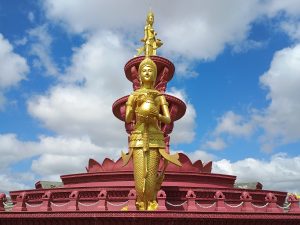
I received an email from Lynn Barreto Miranda about the Mermaid Roundabout in Phnom Penh, Cambodia.
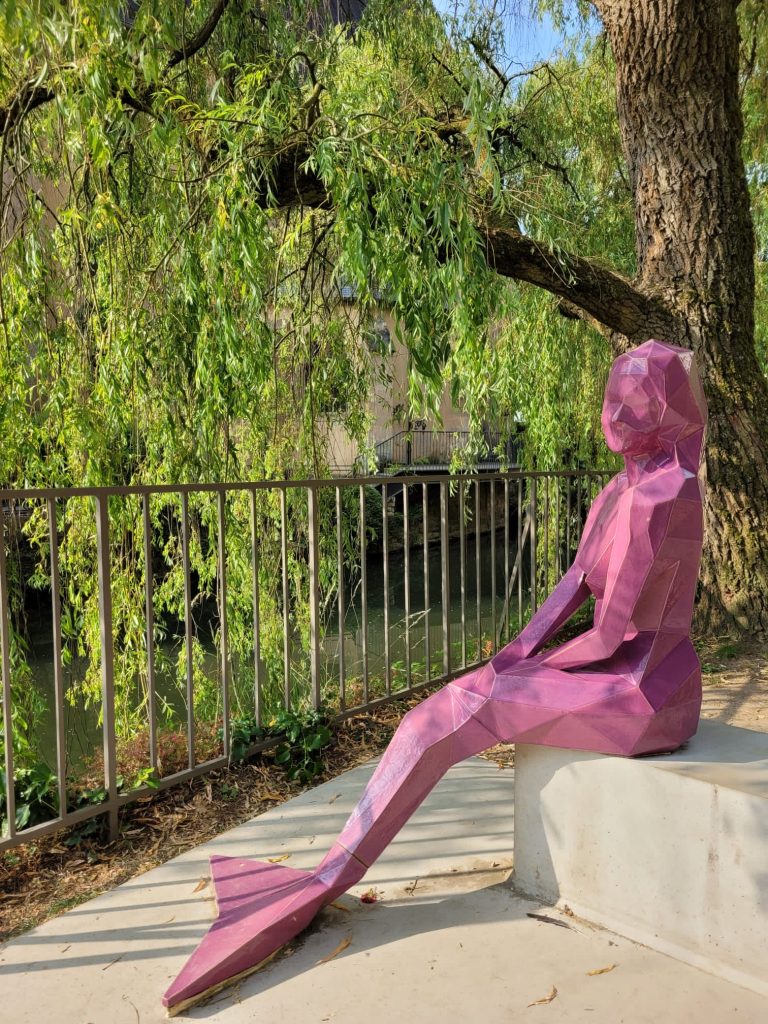
It appears the roundabout and the sculptures in the center were created in the 2016-12017 years, and that it has since become a prominent and well-known landmark.

Lynn took a bunch of photos and has graciously allowed me to feature them on this website.

The story of Melusina of Luxembourg is a beloved legend going back over a thousand years. The tale is one of several different legends in Europe about Melusine or Melusina, including versions in Germany, France and The Netherlands.

Melusina Sculpture
Melusina Sculpture. Photo © by Nicole Wirl

As the Luxembourg tale goes, Melusina is a captivating water spirit or mermaid.

In the legend, Melusina emerges as a water spirit or mermaid who holds a remarkable place in Luxembourg’s history.

The enchanting tale revolves around a captivating maiden, Melusina, who harbored a secret. Whenever she bathed or immersed herself in water, her legs would magically transform into a fish-like tail.

Melusina’s heart was captured by Count Siegfried of Luxembourg, a mortal nobleman. They exchanged vows and became husband and wife, but Melusina extracted a solemn promise from her beloved. He must never venture into her chamber while she bathed, for it was during these moments that she transformed into her true mermaid form.

For years, Melusina and Count Siegfried shared a blissful life together and were blessed with numerous children. However, driven by curiosity or suspicion, Count Siegfried broke his promise and clandestinely observed Melusina during her bathing ritual. To his astonishment, he witnessed her transformation into a mermaid and voiced his surprise. Melusina, filled with anguish and sorrow, escaped his presence and vanished forever.

The legend of Melusina is thus intimately entwined with the House of Luxembourg, a prominent European noble lineage. Interpreted as a symbol of the family’s historical journey with its rise and fall, the House of Luxembourg played a significant role in the medieval epoch, giving rise to several Holy Roman Emperors and Kings of Bohemia.

It is noteworthy that variations of the Melusina legend abound in diverse European cultures. The narrative of a mermaid-like being guarding a cryptic secret can be found in French, German, and other regional folklore. In the case of Luxembourg, the legend of Melusina garnered exceptional prominence, becoming intricately interwoven with the country’s history and identity. Transmitted across generations, it has evolved and ignited the imagination of the people.

Interestingly, Melusina’s association as the progenitor of a noble lineage, with royalty in her family tree, led to depictions of her wearing a royal crown. This imagery has persisted over time, and can still be seen in modern times as the crown in the Starbucks logo.

Follow this link to the page for Mermaid Melusina of Luxembourg.

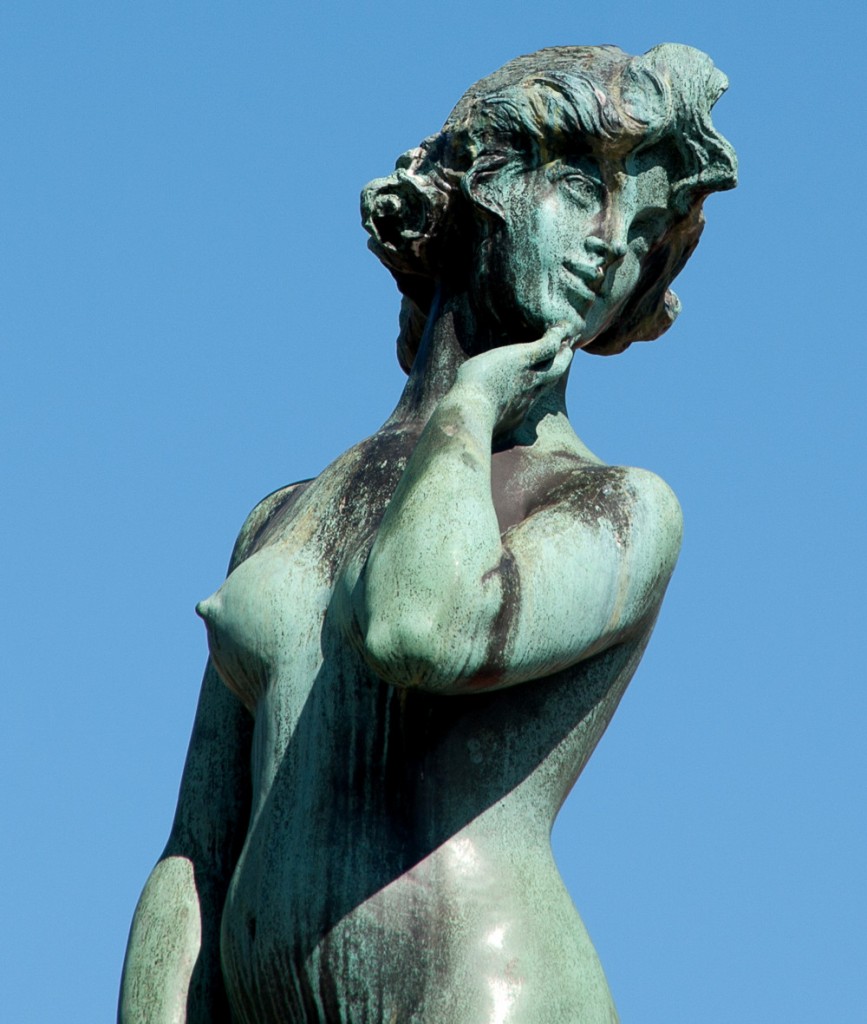
Havis Amanda, the amazing 115-year-old bronze mermaid statue in Helsinki, will be transferred to a conservation facility in early May 2023 for renovations on the fountain and the sculpture. The duration of the repairs will depend on the outcome of archaeological excavations, but the work is expected to continue until August 2024.

Havis Amanda
Havis Amanda in Helsinki. Photo © by Matt Prince.

The fountain and its bronze sculptures are a work of art by artist Ville Vallgren, and the statue has a special significance as part of cultural history and the cityscape since 1908

The statue has been damaged over the years, including during various student and sports celebrations that have prompted people to climb onto it. The salty and windy marine climate has also worn the surface of the sculpture.

“Havis Amanda has undergone minor maintenance on a regular basis, but this is our first opportunity to carry out thorough renovation and conservation procedures,” says Polina Semenova, public art conservator at Helsinki Art Museum.

The cracks and holes in the bronze will be repaired and patinated, and the conservator will also carry out a comprehensive surface conservation process on the bronze parts.

The renovation project will also involve restoring the water basin and foundation of the statue. The depressions on the surface of the square will be fixed, and the traditional pavement will be restored at the end of the project. The technology of the fountain and the related pipelines will also be renovated.

A permanent system will be built to allow for capping ceremonies and maintenance work, so that these can be done without stressing the sculpture itself.

Here is a link to the full page with information on Havis Amanda.

Much has already been written about the Starbucks Mermaid, also often referred to as the Starbucks Siren.  But it is a great story and very relevant to our main topic here, so I’ll cover the highlights here.

According to the Starbucks website, when the Starbucks coffee chain was being started in 1971, the owners wanted to “evoke the romance of the high seas and the seafaring tradition of the early coffee traders” by using a name from the classic novel “Moby Dick” by Herman Melville.  In the book, the name of the whaling ship is Pequod and the name of the Chief Mate on the Pequod is Mr. Starbuck.  It came down to a choice between using ‘Starbucks’ or ‘Pequod’, and we probably all agree that Starbucks was the right choice.

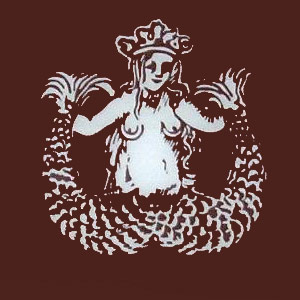
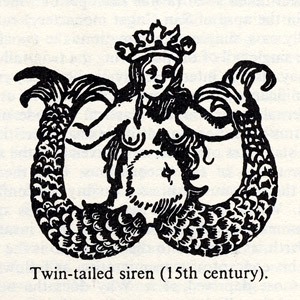
Now that they had a name, the company needed a logo, and in keeping with the theme of the high seas and seafaring, a mermaid was picked for the company logo, inspired by an old – probably 15th century – illustration of a mermaid that can be found in A Dictionary of Symbols by J. E. Cirlot.

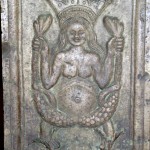
Here is the old illustration of a mermaid image, and the original 1971 Starbucks logo with the mermaid.  It is clearly the same image, with some of the details modified and unnecessary lines removed.

mermaids
15th century illustration

mermaids
Original Starbucks Logo

sb


Twin-tailed mermaid illustrations and sculptures are not uncommon in history at all, dating back at least to the 7th century.  Here are some examples of that:  

Twin-Tailed Crowned Mermaid
 
[Read more…]

You will find the Dartford Mermaid in a small lake near the River Thames in Dartford, England. It was created in 2009-2011 by sculptor William Jordan, and is made almost entirely of recycled materials.

The Dartford Mermaid Statue
The Dartford Mermaid Statue. Photo © by Ian Simpson

The mermaid is about 9 meters (29′) tall, and she measures about 14 meters (46′) from head to tail.

Jordan used old copper hot water tanks, recycled galvanized wire and stainless steel, reclaimed factory floor, crushed concrete boulders and disused natural stone to create the sculpture.  The use of recycled materials symbolizes conservation and harmony with nature.

The location is very close to the site of what was the Littlebrook D power station from 1976 to 2019. The power station and its tall chimney are now long gone, closed down due to environmental protection regulations that the aging power station could not meet.

The mermaid is still there though, with her mission of restoring harmony with nature.

More photos and information can be found on the page for the Recycled Mermaid.

Nathaniel Wheeler’s Bridgeport mermaid sculpture was created in 1912 by famous sculptor Gutzon Borglum (the creator of the Mount Rushmore memorial). It is interesting that he finished this mermaid sculpture the year before Edvard Eriksen created the famous Danish statue of The Little Mermaid in Copenhagen.

Nathaniel Wheeler Memorial Fountain
Nathaniel Wheeler Memorial Fountain in Bridgeport, CT. Photo © by Adrienne Singleton.

Nathaniel Wheeler was a prominent industrialist in Bridgeport, and was very active in city affairs.  His children donated the fountain and the statue to the city in his memory.

The mermaid is rising out of the polished granite pool, and holds aloft a lamp in one hand while holding a baby in the other.  Two dolphins swim at her tail.

More photos and information about the Bridgeport Mermaid is available on the page dedicated to this Nathaniel Wheeler Mermaid.

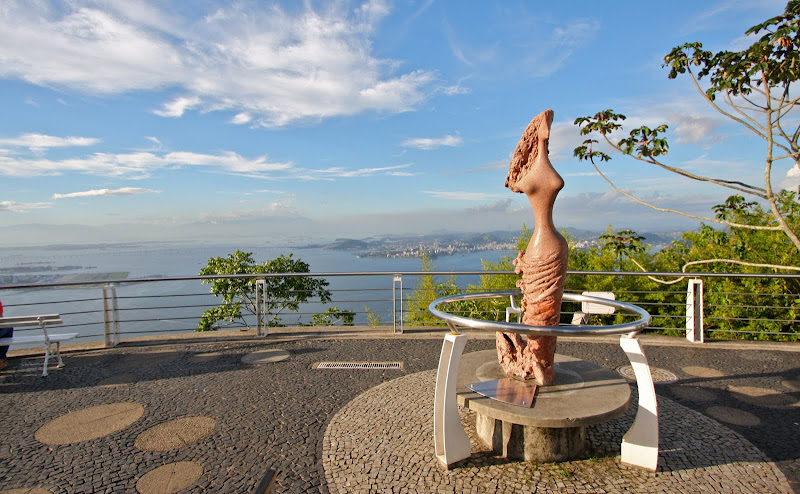
The Guanabara Mitológica sculpture is a very contemporary mermaid sculpture at the top of Pão de Açucar (Sugarloaf Mountain) in Rio de Janeiro’s Guanabara Bay.

The Sugarloaf Mountain Mermaid
 The Sugarloaf Mountain Mermaid statue

She is part of the large installation at the top of this mountain, which has multiple levels of viewing platforms overlook Rio de Janeiro from about 1280′ elevation. Guanabara Mitológica was created by Remo Bernucci, and has a plaque by the statue which reads:

Rio (Mythological Guanabara)
by Remo Bernucci
The Skin – the waves of the sea;
The curved waist – the beaches;
The breast – the mountains;
The hair – the forest;
The silhouette – the gracefulness of the carioca woman;
And at the feet of the statue the ibis.

If you visit, please take some great photos and share with me. I’d love to be able to add more photos of this sculpture in the page for this Sugar Loaf Mountain mermaid.

  • 1
  • 2
  • 3
  • …
  • 23
  • Next Page »
Your Cart

Your cart is empty.

Subtotal—

Shipping & taxes calculated at checkout

The Mermaid Dispatch
◆

Before you go.

One mermaid, every week. The myths, the artists, the places. Delivered Sundays — free.

Something went wrong. Please try again.

No spam. Unsubscribe anytime.

Welcome aboard
◆

Check your inbox.

We’ve sent you a confirmation email. Click the link inside to start receiving the Dispatch.

Loading Comments...