• Home
  • About
    • Ocean Conservation
  • Mermaid Art
    • Artists
    • Mermaid Poems
    • Pictures
      • Public Paintings and Murals
    • Statues
      • Public Mermaid Statues & Sculptures
      • Private Mermaid Statues & Sculptures
      • Mermaid statues and mermaid sculptures for sale
  • Shop
    • Mermaid Jewelry
    • Mermaid Tails
    • Mermaid Books
  • Contact
  • Blog

Syrenka, the Famous Mermaid of Warsaw

June 20, 2017 By Mermaids of Earth Leave a Comment

The city of Warsaw, the capital of Poland, has a mermaid carrying a sword and shield on its coat of arms. That same mermaid is depicted in images throughout the city. Her name is Syrenka (sometimes Syrena) and she is the city’s protector.
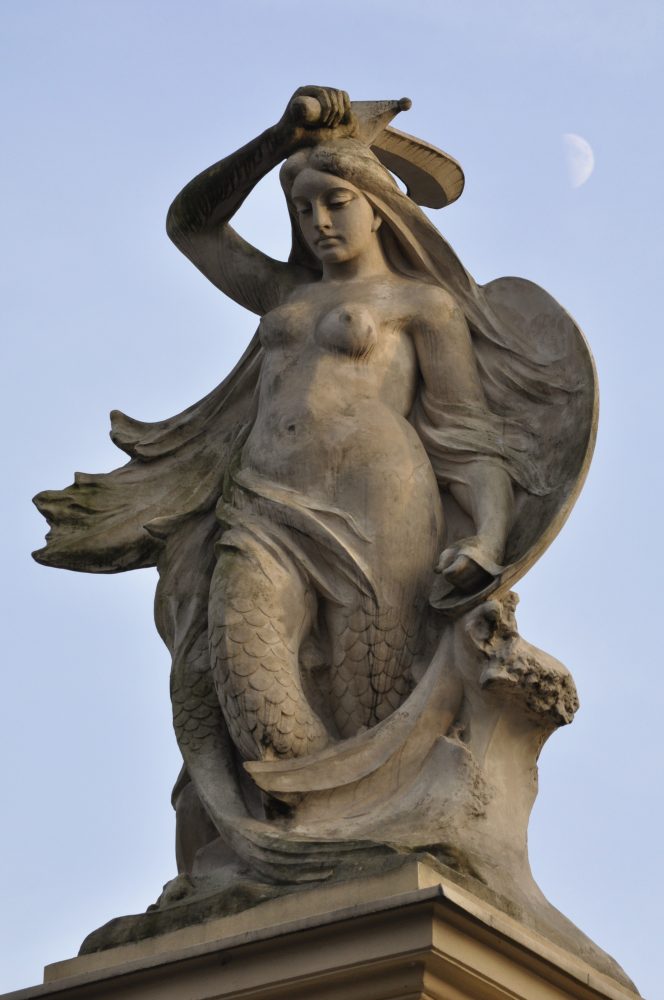
Warsaw's Syrenka Mermaid Statue
Syrenka of Warsaw at Markiewicza Bridge. Photo © Tomasz Dejtrowski

The Warsaw mermaid may not be the oldest instance of a mermaid in human culture, but she is one of the most famous mermaid depictions seen throughout the world. For Warsaw, this mermaid legend is intertwined with its history and the tale is still told to this day by the residents and tour guides of this beautiful city.

Her Common Origins

The words ‘siren’ and ‘Syrenka’ come from the same origin. Those sirens from old sailors’ tales spawned many legends.

Indeed, despite her unique status in Poland as the Warsaw mermaid, Syrenka has a mermaid heritage that is well known and common in many other cultures. That’s because she is really Melusine (also written as Melusina or Meluzyna). As explained in one of my recent posts, Melusine is a famous figure in the history of many European countries, and you even see a representation of her on the Starbucks logo. Her story morphed in a variety of directions as it was told and retold over centuries.

Tale of Two Sisters

The Polish tale of Syrenka begins with two beautiful and vivacious mermaid sisters who lived in the Baltic Sea. They became bored with their lives, approached the shoreline, and went their separate ways. The first sister went to the Danish straits and her image can still be seen today at the entrance to the Port of Copenhagen – the most famous mermaid statue in the word, The Little Mermaid. The second sister went first to Gdansk, on the coast of Poland, then to the mouth of the Vistula River. She rested on the shores of what is known today as Warsaw’s Old Town. From there grew the story of the mermaid of Warsaw.

Syrenka and Old Warsaw

The fishermen of Old Town noticed that their fishing was being hijacked. They set out toward the river’s mouth to find the thief. As they approached, they heard Syrenka singing a song that was so beautiful, they were enchanted and decided to leave her be. In return, she serenaded them every night.

Thus you can see the similarity with the tales of sirens and their captivating songs.

Siren Turned Defender

But Syrenka is not a malicious mermaid. As her story continues, a merchant saw her on the shore and tried to capture her. He was able to trick Syrenka and lock her in a shed, but her cries for help were heard by a handsome son of a fisherman who came to her rescue with some friends. Upon setting her free, Syrenka promised always to defend the village and its people.

Warsaw’s Mermaid: Embedded in the Culture

Syrenka’s promise to protect Warsaw is beloved by the city. Her earliest likeness, complete with sword and shield, appeared in 1652 on the cover of the book Registrum Proventuum et Expensorum Civitatis Antique Varsaviae.

Today, you’ll see the mermaid of Warsaw integrated throughout the city, almost always wielding that sword and shield to defend the people. For starters, she is the defining feature of Warsaw’s coat of arms. She is memorialized in statues and monuments throughout the city. The most famous of these, found in the Old Town Square, was sculpted by Konstanty Hegel and installed in 1855.

Tour guides will happily show you the others:

  • Powisle: Installed in 1939 near the Vistula River.
  • Markiewicz Viaduct: Located on Karowa Street, erected in 1905.
  • Sejm Plenary Hall: A shield engraving placed in 1947.
  • Inzynierska Street: Tram depot 6 entrance.
  • Katowicka Street: School No. 77.
  • Grochowska Street: In front of Praga-Poludnie’s district office.
  • Lindley’s Filters: On the Filtry Lindleya building.
  • Palace of Culture and Science: On each clock face, added before 2000.
  • Bielsko-Biala Square: A memorial built in 1954.

Of course, you will also find Syrenka adorning many souvenirs in Warsaw’s gift shops. Her appearance will forever be part of the city’s rich and colorful history. Her popularity is yet another reminder to us all of the important role mermaids have played in shaping human culture. Long may they continue playing that role and teaching us how to respect each other, our oceans, and our planet.

Creative Commons Attribution: Permission is granted to repost this article in its entirety with credit to Mermaids of Earth and a clickable link back to this page.

Filed Under: Public Mermaid Sculptures Tagged With: mermaid heraldry, syrenka, syrenka mermaid

The Story Behind the Ko Samet Statues

May 9, 2017 By Mermaids of Earth 1 Comment

Ko Samet is a small island in a cluster of islands on the eastern seaboard of Thailand. Its beautiful beaches are a big attraction for foreign tourists as well as residents of nearby Bangkok. One of the beaches, Hat Sai Kaeo, is remarkable for more than just its gorgeous sandy shores. It is the home of the famous Ko Samet statues.

Set on a rock atop the sand, the statues consist of two figures – a flute-playing man dressed in a princely costume of a time long gone and a mermaid. While the people of Thailand are well acquainted with the story behind the Ko Samet statues, tourists to the area often wonder about their meaning.

Yet again, we are privileged to see a great and venerable culture paying tribute to mermaids, as so many have done over the centuries.

The Origin of the Statues

The flute-playing man is Prince Aphai Mani, the hero of an eponymously titled epic poem, Phra Aphai Mani, written by one of Thailand’s most beloved and respected poets, Sunthorn Phu. Phu was a royal poet during the early 19th century who wrote many works that remain popular because they speak about Thailand’s history. This particular poem, Phra Aphai Mani, is today considered a national treasure.

Phu set part of the 30,000-line epic on the shores of Ko Samet. To boil the complicated plot down to its bare essentials, it chronicles the wanderings and romantic adventures and misadventures of Prince Aphai Mani and tells how a mermaid saved him from an ogress by guiding him to the Wonder Island – the present-day Ko Samet.

The Mermaid in the Statues

The phantasmagorical plot follows Prince Aphai Mani as he flees from his father, the King of ancient Siam, who is angry about his dedication to magical flute playing at the expense of managing the kingdom. Unfortunately, the Prince flees right into the arms of an ogress disguised as a beautiful maiden, Nang Phisua Samut, who bears him a son, Sinsamut.

Once Aphai discovers Nang is an ogress, he takes his son and runs away, with Nang in hot, murderous pursuit. Aphai and his son are saved by a mermaid who takes them to Ko Kaew Phitsadan (‘Magic Crystal Island’), which is the former name of Ko Samet.

Inevitably, the Prince falls in love with the mermaid on this paradise island and she gives birth to a son named Sutsakhon. But, as the course of true love never runs smooth, one day a ship passing by the island triggers another series of fantastical events in the life of the Prince, sending him on the next leg of his odyssey across a wondrous terrain: Thailand (as we call it today).

The Meaning of the Ko Samet Statues

There are hundreds of islands in Thailand, so Ko Samet is rightly proud to be singled out by Thailand’s poet laureate. The Ko Samet statues of the Prince and the mermaid who saved him pay tribute to Phu’s great poem and add fame and mystique to the island paradise. They immortalize a folklore story that spotlights a universally recognized motif – the mysterious mermaid as a friend and lover who provides comfort, safety and wisdom.

While Bangkok or Phuket might be the first destinations you think of when visiting Thailand, put the Ko Samet statues of Hat Sai Kaeo Beach at the top of your list. They represent truly one of the most beautiful tributes to mermaid history and culture, placed in an absolutely idyllic setting by white sand and glowing turquoise water.

Creative Commons Attribution: Permission is granted to repost this article in its entirety with credit to Mermaids of Earth and a clickable link back to this page.  See photos and more data on this page about these statues.

Filed Under: Public Mermaid Sculptures Tagged With: koh samet mermaid statue, mermaid ko samet, pisuea samut

A Look Into The Tale – and Tail – of Oannes

May 5, 2017 By Mermaids of Earth Leave a Comment

Many mythologies feature mermaids, mysterious half-fish, half-human beings. Various cultures worshiped or feared them as deities or spirits. Most have been female, hence the name mermaids. Their male counterparts make rarer appearances in folklore, but there were a few. One of them, Oannes, actually predates the first recorded mermaid – Atargatis, the Assyrian goddess – by several thousand years.

Who Was Oannes?

Oannes, also known as Adapa and Uanna, was a Babylonian god from the 4th century BCE. It was said he appeared out of the ocean every day as a fish-human creature to share his wisdom with the people along the Persian Gulf. In daylight hours he taught them written language, the arts and sciences, then returned to the sea at night.

Oannes did not necessarily look like how we might picture a merman. Some artwork shows him to have a human torso and fish tail, but other materials (including carvings) show a human body with arms, legs and feet surrounded by the form of a fish. You could almost say it looked like a giant fish ‘costume’.

We know of Oannes mainly through the stories of a 3rd century BCE Babylonian priest and scribe named Berossus. Only fragments of his writings survived, so the tale of Oannes has been handed down mainly through the summaries of his writings by Greek historians. One fragment reads:

At first they led a somewhat wretched existence and lived without rule after the manner of beasts. But, in the first year after the flood appeared an animal endowed with human reason, named Oannes, who rose from out of the Erythian Sea, at the point where it borders Babylonia. He had the whole body of a fish, but above his fish’s head he had another head which was that of a man, and human feet emerged from beneath his fish’s tail. He had a human voice, and an image of him is preserved unto this day. He passed the day in the midst of men without taking food; he taught them the use of letters, sciences and arts of all kinds. He taught them to construct cities, to found temples, to compile laws, and explained to them the principles of geometrical knowledge. He made them distinguish the seeds of the earth, and showed them how to collect the fruits; in short he instructed them in everything which could tend to soften human manners and humanize their laws. From that time nothing material has been added by way of improvement to his instructions. And when the sun set, this being Oannes, retired again into the sea, for he was amphibious.

From Ancient Fragments, by I.P. Cory.

In fact, the names of Oannes and the other six sages of civilization – the Apkallu – are engraved in a Babylonian tablet found at Uruk, the ancient city of Sumer (today the city of Warka in Iraq).

Berossus the Scribe

Berossus wrote three books on the history and culture of Babylonia. Although only fragments of his writings remain, Berossus was well known to historians of his day, as well as those who came later, and was mentioned in their accounts. Indeed, his historical chronologies and writings have been verified for compatibility with other writings of the time by modern scholars.

What Are We to Make of the Tale of Oannes?

Is it possible then that there is some truth behind the story of Oannes the mermaid? Could it be that that mysterious figure who emerged from the sea onto the Babylonian shore thousands of years ago to enlighten mankind and bring civilization to the world actually existed? Or was Oannes, the all-knowing man-god in fish form, a way for Berossus to explain the mysterious genesis of civilization in terms people of his time would understand? Yet again, we see the concept of a merman/mermaid assisting humankind and being an object of reverence, so it is logical to assume that the connection with many other mermaid tales is not a mere coincidence.

We can only hope more writings about Oannes are discovered because his tale remains tantalising to this day!

Creative Commons Attribution: Permission is granted to repost this article in its entirety with credit to Mermaids of Earth and a clickable link back to this page.

Filed Under: Public Mermaid Sculptures Tagged With: oannes mermaid, oannes myth, syrian mermaid

Five Endangered Marine Species – Can We Save Them?

April 30, 2017 By Mermaids of Earth Leave a Comment

Earth is still the only place we humans have confirmed as supporting life. Of the millions of species on our planet, the oceans contain several million, many as yet undiscovered.

Despite Earth’s surface being 70% covered by water, the oceans are the most unexplored parts of it. Yet oceans are massively important to climate and to the health and wellbeing of so many forms of life. Marine ecosystems have a very delicate balance but they are being disrupted by many influences. Thus the list of endangered marine species is ever growing. Without the help of those on land, some beloved creatures of the sea don’t stand much of a chance.

The Mermaid Connection

The sea has always been a source of great mystery and awe for humans. Stories, legends and myths have risen from the watery depths over thousands of years. Some have been about terrifying monsters, ghost ships, deities, spirits, and of course mermaids.

All of these stories – true or otherwise – convey one simple message: respect the ocean and all that is in it. Mermaids represent an integral part of that message and you will find that mermaid enthusiasts are also keen marine conservationists. Mermaids through history have commanded awe and reverence, which extends to the waters from which they came and the other forms of life within. Woe has befallen all those who have not shown respect, and that applies today as the loss of endangered marine species will bring problems for all of us.

Manatee – the Mistaken Mermaid

On a voyage through the Caribbean, Columbus saw manatees and thought they were mermaids. There are several varieties of this gentle giant. Officially, the West Indian manatee (of which the Florida manatee is a sub-species) has moved from endangered to threatened, but environmental groups believe this ‘upgrade’ is premature and misguided. Either designation is not good. This beautiful creature faces threats from traffic in its habitat, fishing, unsafe boating practices, toxic environmental runoff, and illegal hunting.

Hawksbill Turtle – Critically Endangered

Sadly, this turtle’s protective shell can do little to keep it safe from those putting it in dire jeopardy. Found in the tropical regions of the world, the Hawksbill turtle has seen a population decline of nearly 80 percent over the last century, largely due to poaching for its meat and shells.

Steller Sea Lion

Many mermaid myths were birthed from the sight of creatures like seals and sea lions. If only mermaids could look after the Steller Sea Lion because its population has declined more than 60 percent.

Humpback Whale

Massive yet graceful, intimidating yet passive, humpback whales have a rich history that is intertwined in many ancient cultures. When they talk to each other, their songs are gorgeously enchanting. However, due to human greed and ignorance, entanglement in fishing nets, and marine pollution, humpback numbers have dropped terribly. While it has been announced that several humpback populations are no longer endangered, this serves as an invitation to poachers.

Scalloped Hammerhead Shark

Undoubtedly one the odder looking creatures in our oceans, the Scalloped Hammerhead shark is in danger as it is hunted and killed for its prized fins. Although many nations across the globe are making efforts to abolish the use of shark fins, it is still happening – illegally.

Sadly, there are so many more endangered and threatened marine species. It is up to all humans to show greater respect, spread education, and implement practices that will protect our oceans and the creatures therein. We at Mermaids of Earth are proud to support marine life in all forms and promote people and groups that raise awareness and take positive action. Please join us in this quest.

Creative Commons Attribution: Permission is granted to repost this article in its entirety with credit to Mermaids of Earth and a clickable link back to this page.

Filed Under: Public Mermaid Sculptures

Three Famous Mermaids from History

April 21, 2017 By Mermaids of Earth Leave a Comment

Human history is filled with mermaid legends. Men and women from just about every corner of the earth have spun yarns, written literature, and created art about creatures and spirits from the water. Some mermaid tales have revolved around spiritual beliefs, some have been about explaining the unexplainable, while others have acted as warnings about the perils of the ocean. These stories have captured the imaginations of people for millennia and will continue to do so for a long time to come. I have mentioned several throughout this website. Here are three more famous mermaids.

Atargatis

The myth of Atargatis is one of the oldest, dating back to 1000 B.C.E. Atargatis was the Assyrian goddess of fertility who protected her people around what is today northern Syria and Iraq. Her followers formed a cult and created a temple near a lake or pool. Although all surviving visual symbols and icons of Atargatis show her to have human characteristics, the legend of her being a mermaid endures. The story mentions her falling in love with a human shepherd but killing him by accident. Overcome with grief, shame and guilt, she retreated to a lake to hide. In a bid to conceal her great beauty and remain hidden in the water, she tried changing herself into a fish, but could not. Only her lower half transformed into a fish tail.

Atargatis’s legend spread throughout the ancient Near East, reaching as far as Rome and Greece. Her legacy is as the mother of fertility, revering fish and doves as sacred and protecting them.

Sedna

In the great far north of Canada, the Inuit people tell of the goddess Sedna. (To different Aboriginal peoples, she is known as Tallelayuk, Takánakapsâluk, Takannaaluk, Nuliajuk, Arnapkapfaaluk, and other names.) Sedna is the goddess of both sea and land. There are several legends about her, but they all involve her in the ocean. In perhaps this mermaid’s most famous origin story, Sedna mistakenly married a bird spirit disguised as a man and was kidnapped by it. Her father rescued her in a kayak, but the enraged bird spirit flapped its wings to create a storm of large waves. Trying to keep Sedna from the spirit’s clutches, her father pushed her into the sea. As she clung to the kayak in the frigid water, her fingers froze, snapped off and sank (in some versions, her own father cut them off) where they became whales, walruses, and other sea animals. Sedna herself grew a fish tail and thus is revered as the mother and spirit of the sea. Some Inuit believe Sedna protects sea creatures so they can be found by hunters and used to sustain the people.

Undines

Undines (sometimes spelled ondines) are spirits or nymphs that represented the classical element of water. Other spirits represented fire, earth and air. Undines are invariably depicted as beautiful females of the water, often with fish tails. Undines were said to occupy waterfalls or pools, and, much like the tales of sirens, they had beautiful and enticing singing voices. Some say that mermaids are even a species of undines.

Writers and playwrights of the 18th and 19th centuries took the ancient Greek concept of undines and developed it. The story became that Undine – a solitary female character, instead of a group – promised her uncle that if her mortal lover was ever unfaithful to her, she would no longer be the source of breath for his lungs. When her lover planned to marry another woman, Undine took her breath from him and he perished. Today, there is a rare form of sleep apnea that endangers the automatic process of breathing that is unofficially called ‘Ondine’s Curse’.

Considering our planet’s surface is 70% water, it is totally understandable that mermaids are famous in so much of human folklore and are interwoven into our cultures. Their stories have enriched people’s lives for many generations and I, for one, intend for their enchanting legacy to continue forever.

Creative Commons Attribution: Permission is granted to repost this article in its entirety with credit to Mermaids of Earth and a clickable link back to this page.

Filed Under: Public Mermaid Sculptures Tagged With: historical mermaids, mermaid stories, mermaid tales

The Best Mermaid Shows

April 8, 2017 By Mermaids of Earth Leave a Comment

Would you like to see mermaids? Who wouldn’t? After thousands of years and multiple legends about them in many different cultures, mermaids continue to charm and even educate humanity. Their stories have blurred the lines between fact and fiction, inspired countless voyages, and mesmerized men and women with their enchanted ways. Images of them reveal such grace and beauty in the water. Fortunately, some wonderful people have created mermaid shows so that all of us can experience a little real life wonder and fun, without watching a movie, scouring the internet, or looking through libraries. The US has some excellent real life mermaid shows that are sure to leave you in awe.

Weeki Wachee Springs, Florida

Weeki Wachee may have an official population of only a dozen people, but since 1947 this place just north of Tampa and Clearwater in Florida has been a tourist attraction and home to the world’s most famous mermaid show. Weeki Wachee Springs is actually a Florida state park. The shows boast 28 full-time mermaids who perform 30-minute sets three times daily in a setting filled with fascinating marine life and exhibits.

The Sip ’n’ Dip Lounge, Montana

If you think that landlocked Montana isn’t the place to go to see mermaids, you would be mistaken. Once voted by GQ Magazine as the number one bar on the planet worth flying to, the Sip ’n Dip Lounge in Great Falls is truly a sight to behold. An expansive pool with windows behind the bar house mermaid shows seven days a week as you listen to the legendary Piano Pat sing. With a large drink menu and kitschy tiki decor, this destination is one where you come for the mermaid show but stay for the ambiance.

Ripley’s Mermaids, South Carolina

Located in vacation hot spot Myrtle Beach, SC, the beloved Ripley’s Aquarium is already home to hundreds of species of marine life – and mermaids. With live shows and even ‘meet and greets’ with the mermaid performers, Ripley’s Aquarium is a great place to take your family.

The Silverton Casino’s Mermaid Aquarium, Nevada

Las Vegas is known for many things – desert, casinos, shows, and more. Add mermaids to that list. At the Silverton Casino’s Mermaid Lounge, you can watch an interactive feeding show with real life mermaids in a huge tank. Watch these breathtaking creatures in daily performances as they feed exotic and beautiful marine life right before your eyes. As you can see here, kids and adults alike love it, especially how interactive the show is.

Downtown Aquarium’s Mystic Mermaids, Colorado

Yet another unlikely location for a mermaid show – high above sea level. At the Downtown Aquarium in Denver, you can be dazzled by the Mystic Mermaids. With regular shows in the latter part of each week, including dining shows and ‘meet and greets’, this is an amazing opportunity to watch mermaids swim with their aquatic friends. All performers had to meet exceptional standards to be part of Mystic Mermaids and they’ll even educate the audience about the importance of looking after our natural environment.

Dive Bar, California

Located in California’s capital city, Sacramento, the name Dive Bar is meant literally. For on top of their sleek decor and extensive drink menu, they allow you the opportunity to witness mermaids and mermen swim among the fishes in a 7,500-gallon tank. Marvel at mermaids swimming above your head as you sit at the bar. This is definitely a mermaid show you don’t want to miss.

Let’s face it… mermaid shows are fun! It’s not that easy to find and see mermaids in the open ocean, so the next best thing is to see them up close as you relax, drink and dine in comfort. I’m ready to book my next vacation right now.

Creative Commons Attribution: Permission is granted to repost this article in its entirety with credit to Mermaids of Earth and a clickable link back to this page.

Filed Under: Public Mermaid Sculptures Tagged With: live mermaid show, seeing mermaids, weeki wachee mermaid show

Who Was Amphitrite and Why is Her Statue Off Grand Cayman Island?

April 1, 2017 By Mermaids of Earth 2 Comments

There is no shortage of beautiful sights in the Caribbean, but there is one that only so many can see… because it is in 55 feet of water off Grand Cayman Island. It is this magnificent mermaid statue named Amphitrite. Thousands of divers flock to Grand Cayman to see Amphitrite every year.

Amphitrite is a 9 foot tall, 600-pound bronze mermaid statue located off the beach of Sunset House Resort. Created by Canadian sculptor and avid SCUBA enthusiast, Simon Morris, and installed in 2000, Amphitrite is actually the second of her kind. In 1989, the first statue, named the Emerald Princess, was placed in the waters of Powell River, British Columbia, Canada. These two statues are virtually identical.

While BC’s Emerald Princess is a great attraction with dive enthusiasts, it is Amphitrite who attracts even more attention due to her location in the glorious warm waters of idyllic Grand Cayman.

Who Was Amphitrite?

In Greek mythology, Amphitrite was the wife of Poseidon, the great god and protector of the sea. She was the eldest of the Nereids, a group of 50 sea nymphs who were all daughters of Nereus (‘the old man of the sea) and Doris the Oceanid. Considered to be the personification of the entire sea, Amphitrite is also known as the mother of seals and dolphins.

The tale tells that Poseidon saw Amphitrite dancing in the water and fell desperately in love with her. He asked for her hand in marriage, but Amphitrite refused and swam away to hide with Atlas near the ends of the earth and protect her virginity. Never one to give up, Poseidon enlisted the help of his loyal friend Delphin, a dolphin sea god and leader of all dolphins, to find her and convince her to marry him. Thankfully for the god of the sea, Delphin was persuasive and Amphitrite eventually agreed to the proposal. So grateful was Poseidon for Delphin’s help, he placed the image of the dolphin among the stars as the constellation Delphinus.

Between them, Poseidon and Amphitrite had 3 children, including the sea god Triton, a merman in appearance. It is believed that this depiction of Triton – human above the waist and fish below – is the source of much of the western world’s typical image of a merman (and mermaid).

Legend has it Amphitrite was even present at the birth of Apollo.

Today, the name Amphitrite is still recognized as being synonymous with the sea. Several ships of the British and US navies were named after her over the centuries.

Grand Cayman Island

In 2000, after a year of planning, Simon Morris’s gorgeous sculpture of Amphitrite was lovingly given its resting place 55 feet below the waters of Sunset Reef, about 130 yards off the shore of Grand Cayman. Her official name is Amphitrite, Siren of Sunset Reef. She is a Mecca for divers from across the globe and inspires awe in all who see her up close.

A New Companion!

In 2015, Amphitrite was given a male companion a short distance away on a reef at Light House Point, Grand Cayman Island. The half-human, half-seahorse Guardian of the Reef stands an imposing 13 feet tall, with shield and staff in hand to symbolize the quest to protect the marine environment.

Together, Amphitrite and the Guardian of the Reef make Grand Cayman Island an even more attractive destination and a source of great wonder and joy for thousands of diving and mermaid enthusiasts.

Creative Commons Attribution: Permission is granted to repost this article in its entirety with credit to Mermaids of Earth and a clickable link back to this page.

Filed Under: Public Mermaid Sculptures Tagged With: goddess of the sea, grand cayman mermaid statue, mermaid sculptures

The Legend and Mystery of Selkies

March 23, 2017 By Mermaids of Earth Leave a Comment

Just about every corner of the world has lore and legends about mermaids. For the most part, they are depicted as mean-spirited tricksters who often lured people to their deaths. This may come as a surprise to anyone who knows only the romantic stereotype of mermaids.

However, there are some myths about creatures from the sea that are unlike all the others and still captivate the imagination today: the mysterious selkies.

From the North Sea and North Atlantic

Selkies (sometimes ‘selchies’ or ‘silkies’) feature in the folklore of people from northern Scotland, Ireland, the Shetland Islands, and the Faroe Islands (Danish territory north of Scotland between Iceland and Norway). While many tales about part-human, part-fish creatures from the sea end in tragedy for mortal people, selkies changed from being seals to humans, and their stories enjoy a more romantic quality, although with some heartache as well.

Some people believe that the legends surrounding selkies arose when early Scottish settlers and shipwrecked sailors married dark-haired, fur-wearing Finnish native women and Sami people (sometimes called Laplanders).

Not Your Typical Mermaid

Male and female selkies were said to be seals when in the ocean, but could shed their skins to live on land as humans.  Whichever form they were in, selkies tended to long for the other form and the other life. Nevertheless, they could remain human for some time provided their seal skins were well hidden from them. Upon finding their skins, they would have to return to the water.

Alluringly Beautiful

Both female and male selkies in human form were usually described as being classically beautiful or alluringly attractive. Some stories depict the males as ‘predators’ of a sort, often coming ashore to seduce women who were dissatisfied in their marriages or lonely in their day-to day-lives, like fishermen’s wives. Other tales mention lonely human females summoning male selkies by shedding seven tears into the sea.

Female selkies were said to be incredibly beautiful as humans and made excellent wives and mothers. But if a female selkie found her seal skin again, she would immediately return to the water, even leaving behind a husband and children.

Possible Meanings Behind Selkies

Like most myths, stories of selkies may have been attempts to explain the unexplainable and find some kind of comfort. Instead of being mere romantic fantasies about being lured away by a gorgeous lover, it’s possible that selkie stories may have been about explaining why a woman might have an affair and/or leave her family. Or they could have been an attempt to explain people who were different and didn’t fit in, perhaps even those who had webbed fingers or scaly skin.

Life dependent on the ocean was always unpredictable for the people of the North Sea and Northern Atlantic, with the sea sometimes giving and other times taking away. The concept of seal people becoming human and imparting joy before returning to the water and leaving things behind certainly fits the pattern of the ocean giving and taking. For all we know, some stories may have been ways of explaining the tragedy of death in the water.

Today, selkies remain virtually unknown to most of the world. That is a pity, because their stories are very ‘human’, revolving around life and love instead of intentional harm and death.  Of all mermaid legends, selkie tales are among the most touching, even bewitching, and teach us much about the beauty and nature of our own humanity.

Creative Commons Attribution: Permission is granted to repost this article in its entirety with credit to Mermaids of Earth and a clickable link back to this page.

Filed Under: Public Mermaid Sculptures Tagged With: merrows and selkies, scottish mermaid legend, selkie stories

A Dip Into the Story of Melusine

March 16, 2017 By Mermaids of Earth 1 Comment

Unless you know your mythology, you might be thinking, “Who or what is Melusine? A medication? A monster from Harry Potter?”

Melusine is a mythical creature that everyone has seen hundreds of times and yet few people have known what they were looking at or have given it a second thought.

The next time you see the Starbucks logo, take a closer look. See the mermaid with two tails? THAT is a representation of Melusine. Why is she on that logo? As you will quickly learn, her story is richer and deeper than anything on the Starbucks menu and reminds us that tales of the supernatural remain part of the human experience to this very day.

The Origins of the Legend

Melusine is a water sprite (or faerie) from antiquity. The earliest written accounts seem to be some French writings of the 14th and 15th centuries. But the legends may go back much farther.

The French stories, translated into German and English in around the 15th century, told of Elynas, King of Albany (another name for Scotland at the time), who went hunting and met a beautiful woman, Pressyne, in the forest. Pressyne married the King and gave birth to triplets, three daughters named Melusine, Melior, and Palatyne. However, the King broke a pact (it seems like an early pre-nuptial agreement) of not entering the chamber where the children were born and bathed. Pressyne took the girls and traveled to Avalon, an island from the Arthur legend. On Melusine’s fifteenth birthday, she asked why they had traveled to Avalon. When she was told of her father’s broken promise, Melusine wanted revenge and convinced her sisters they should capture him and lock him up. Pressyne punished them. As the instigator, Melusine received more severe punishment and was condemned every Saturday to take the form of a serpent from the waist down. In some stories, her form was that of a two-tailed mermaid.

Blurred Legends

After this point, the stories become harder to assimilate. Legend has it that a Duke married Melusine and she forbade him to see her in her chamber on Saturdays, but he also broke the promise. Before then, some tales say she bore him ten sons (several of whom became kings) and the land prospered. After discovering that her husband knew her Saturday secret, Melusine turned into a mermaid/serpent for life.

Thus the Melusine stories were blurred into ruling customs of feudal life to provide a supernatural element to wielding power. The ruling houses of northern France and Luxembourg took to the stories particularly, with some claiming to be direct descendants of Melusine.

Even the Arthur legend ties in. The Lady of the Lake, who produced the sword from the water and also raised the young Lancelot, is said to be a water nymph like Melusine.

Melusine Today

There are more references and tributes to Melusine still around today than you may be aware of – aside from the Starbucks logo.

In Czech and Slovak languages, there is a word meluzina. It means a wailing wind and links to the idea of Melusine searching for her children.

Over the centuries, Melusine’s story has been in books, poetry, a Dvorak opera (Rusalka), plays, paintings and sculptures. She was the inspiration for the character Mélisande in a play, later adapted into a Debussy opera. Even some songs of the 21st century have been written or named for her. See here, here and here.

Why Starbucks?

The founders of Starbucks wanted to link their product to Seattle’s proximity to the ocean and the spirit of adventure connected with seafaring. From there they studied Moby Dick and tales of sirens. They came across Melusine and a logo was born.

So, next time you down a Venti Latte, you can see a connection to one of the great mermaid tales of history.

Creative Commons Attribution: Permission is granted to repost this article in its entirety with credit to Mermaids of Earth and a clickable link back to this page.

Filed Under: Public Mermaid Sculptures Tagged With: melusine legend, melusine starbucks, starbucks mermaid

The Cultural Significance of Mermaids Around the World – Part 2

March 9, 2017 By Mermaids of Earth Leave a Comment

So many cultures have amazing myths and stories about mermaids or creatures like them. The form and interpretation you probably know best comes from Hans Christian Andersen’s tale The Little Mermaid, which is immortalized in the world’s most famous mermaid statue in Copenhagen Harbor.

But the history of mermaids runs deep and wide. Greek mythology features King Triton, a merman protecting the deep. Homer’s Odyssey mentioned sirens that could have been mermaids and his work has influenced so many tales. Numerous cultures have worshipped human-fish deities or told stories of such creatures or spirits, believing them to be immortal or to possess special powers. Ocean explorers over the centuries told of mermaid sightings. Columbus himself apparently once saw manatees and mistook them for mermaids. And, of course, part 1 of this blog examined ancient mermaid lore from Japan, Africa and Brazil.

These and many other examples make it clear how profoundly mermaid culture has influenced the human imagination.

Western Europe and the Starbucks Logo

starbucks-mermaid

You know the mermaid on the Starbucks logo? That is a depiction of a mermaid, the waterspriteMelusine. Several cultures of Europe have told stories of Melusine and her serpent-like double tail. Those stories appear in some literature and folklore of Germany, Luxembourg, Albania, and France. Melusine is especially connected with France as the royal house of Lusignan (that ruled much of Europe from the 12th to the 15th centuries) claimed to be descendants of her.

Slavic Rusalka

Rusalka have a mixed history – sometimes depicted as water nymphs who helped irrigate crops, while other times as spirits of dead girls who lured people to death in the water. (There’s that similarity to sirens again.) These tales came from Slavic cultures and were widely spread in Russia.

Scotland

Beyond kilts, haggis and William Wallace, there are mermaids in Scottish folklore. Known as selkies, these gentle creatures were believed to have lived as seals while in the water, but shed their skin on land and lived as humans. Legend has it that once ashore, selkies’ skin could be stolen, whereupon they would remain human, marry humans, and have children. Tragedy came later as they would eventually find their old skin and return to the sea, leaving their families.

Another story from the 19th century claimed a Scottish boy threw rocks at a mermaid, killing it. That mermaid was depicted as looking like a child. It presents yet another demonstration of how mermaid tales have gripped human imagination.

Ireland

From Gaelic legends, merrows(the name is similar to mermaid and merman) were believed to wear a magic cap called the cohuleendruith, which allowed them to live underwater. Female merrows were beautiful half-fish, half-humans. Male merrows, on the other hand, were usually depicted as ugly and cruel. Similar to the Scottish selkies, female merrows often would marry humans. However, inevitably they would tire of land and return to the sea, sometimes with or without their families.

New Zealand

Traditional Maori culture in New Zealand features carvings representing Marakihau, a monster with the head of a human and the body of a long fish. It is usually depicted having a long tongue that sucked up men and canoes, causing tragedy.

Norway

There is a Norwegian legend about Finfolk – shape-shifting nomads who were equally at home on land as in water and were believed to be hostile to humans. According to folklore, the Finfolk would often abduct humans and make them their spouses, treating them more as servants than partners. They loved silver, so it was believed that one of the only ways to escape Finfolk was to throw a silver coin at them.

Asian Cultures

mermaid-swimming-in-waterThere are accounts of mermaids in ancient Chinese literature. Even the Hindu religion and folklore of Thailand and Cambodia mention a mermaid princess named Suvannamaccha. Mermaid records across Asia are not as extensive as in other parts of the world, but, as with all culture of the East, they are always fascinating and multi-layered.

After reflecting on this two-part blog, it’s clear that mermaid culture and stories have permeated just about every culture on earth. Many tales bear striking similarities, despite having local variations and differences. Because of those similarities, some people have wondered if the stories started in one place and were spread worldwide by word-of-mouth, or if we humans share an unexplained mystical connection with water. One thing is certain… mermaids have affected human culture more deeply and profoundly than one might first think and will continue to do so for generations to come.

Creative Commons Attribution: Permission is granted to repost this article in its entirety with credit to Mermaids of Earth and a clickable link back to this page.

Filed Under: Public Mermaid Sculptures Tagged With: mermaid history, mermaid legends, mermaids of the world

  • « Previous Page
  • 1
  • …
  • 11
  • 12
  • 13
  • 14
  • 15
  • …
  • 23
  • Next Page »

Loading Comments...