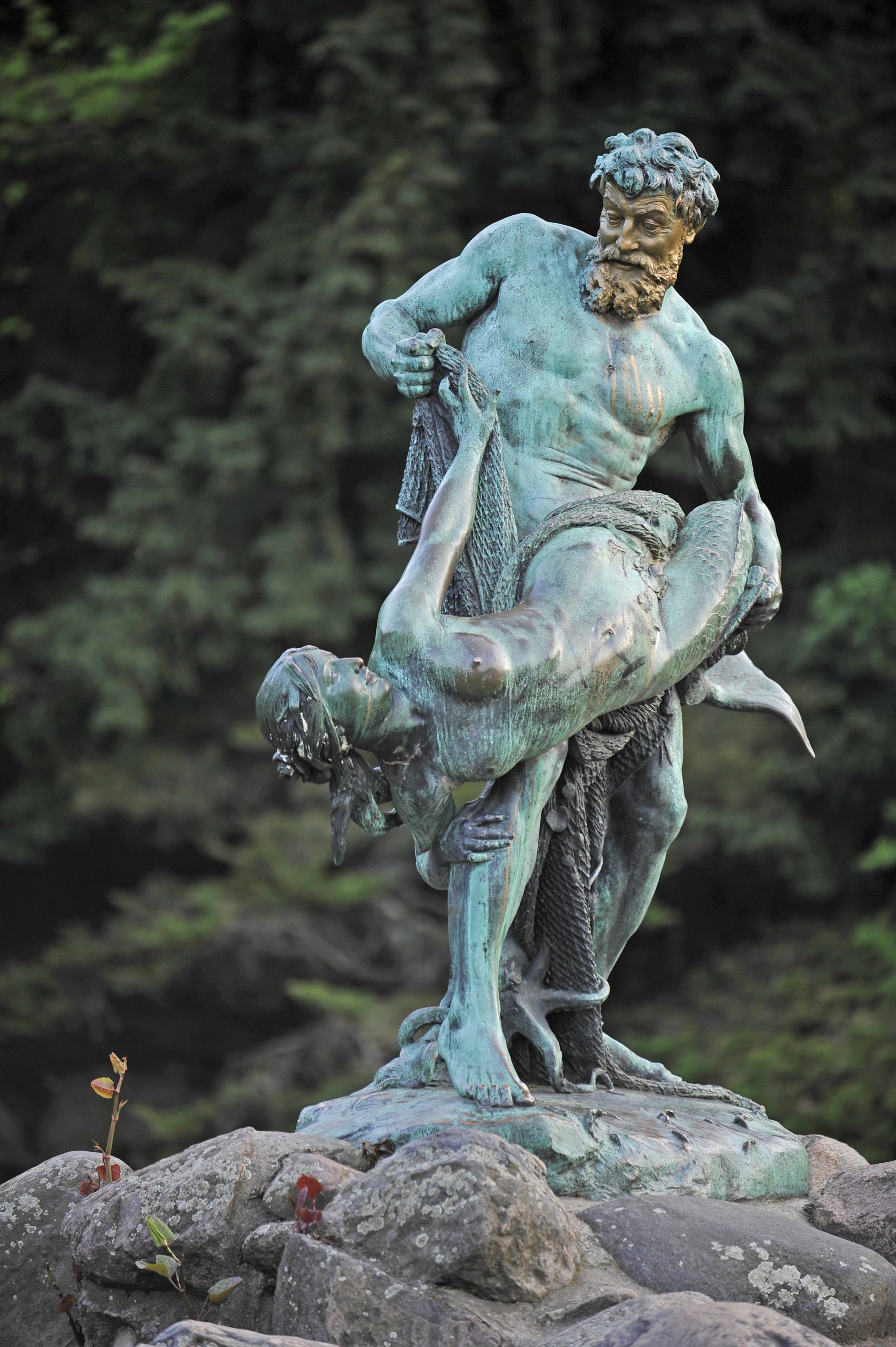
This bronze sculpture called Der Seltene Fang (The Rare Catch) by Ernst Herter was unveiled in 1896 in Berlin's ViktoriaPark, depicting a fisherman struggling to keep hold of a twin-tailed mermaid caught in his net. map
The Sculptor:
Ernst Herter (1846–1917) was one of Imperial Germany's most celebrated sculptors, working in a neoclassical tradition across bronze and marble. His most famous work — Sterbender Achilles (Dying Achilles, 1884) — was acquired by Empress Elisabeth of Austria and became the centrepiece of her Achilleion Palace in Corfu. He also created the Lorelei Fountain in the Bronx, New York, originally intended for Düsseldorf but rejected due to antisemitic sentiment in the German Reich.
The Sculpture:
The fisherman in the sculpture is depicted as a male nude, straining to keep hold of a twin-tailed mermaid still partially tangled in his net. At his feet, an octopus. Contemporary accounts noted the work's barely concealed erotic allusions — unusual for a public commission in Wilhelmine Berlin, even one destined for a park rather than an official building. Herter had been developing the idea since 1891, when he produced a smaller model titled Ein seltener Fisch (A Rare Fish). The final bronze arrived five years later.
The Park:
Viktoriapark is named after Princess Victoria — the British princess who became Queen of Prussia. Its dominant landmark is a cast iron monument designed by Karl Friedrich Schinkel in 1815, commemorating the Napoleonic liberation wars. In summer, an artificial waterfall flows from the monument's base down the hillside to street level, where the lower pond and the fisherman's statue wait at the bottom. The park also maintains two small vineyards on the Kreuzberg hill's slopes, producing around 600 bottles of "Kreuz-Neroberger" wine each year.
References:
● https://en.wikipedia.org/wiki/Ernst_Herter
● The Mermaids of Earth coffee-table book: See page 55 in the book about this sculpture.