On the harbour front of Funchal, the capital of the Portuguese island of Madeira, a bronze mermaid rises from a dark boulder at the edge of the marina. Known simply as the Sereia — Portuguese for "mermaid" — she sits among the moored yachts of the Marina do Funchal, with the amphitheatre of the city and its hillsides rising behind her. She is the work of the Madeiran sculptor Ricardo Velosa and dates from 1989. map
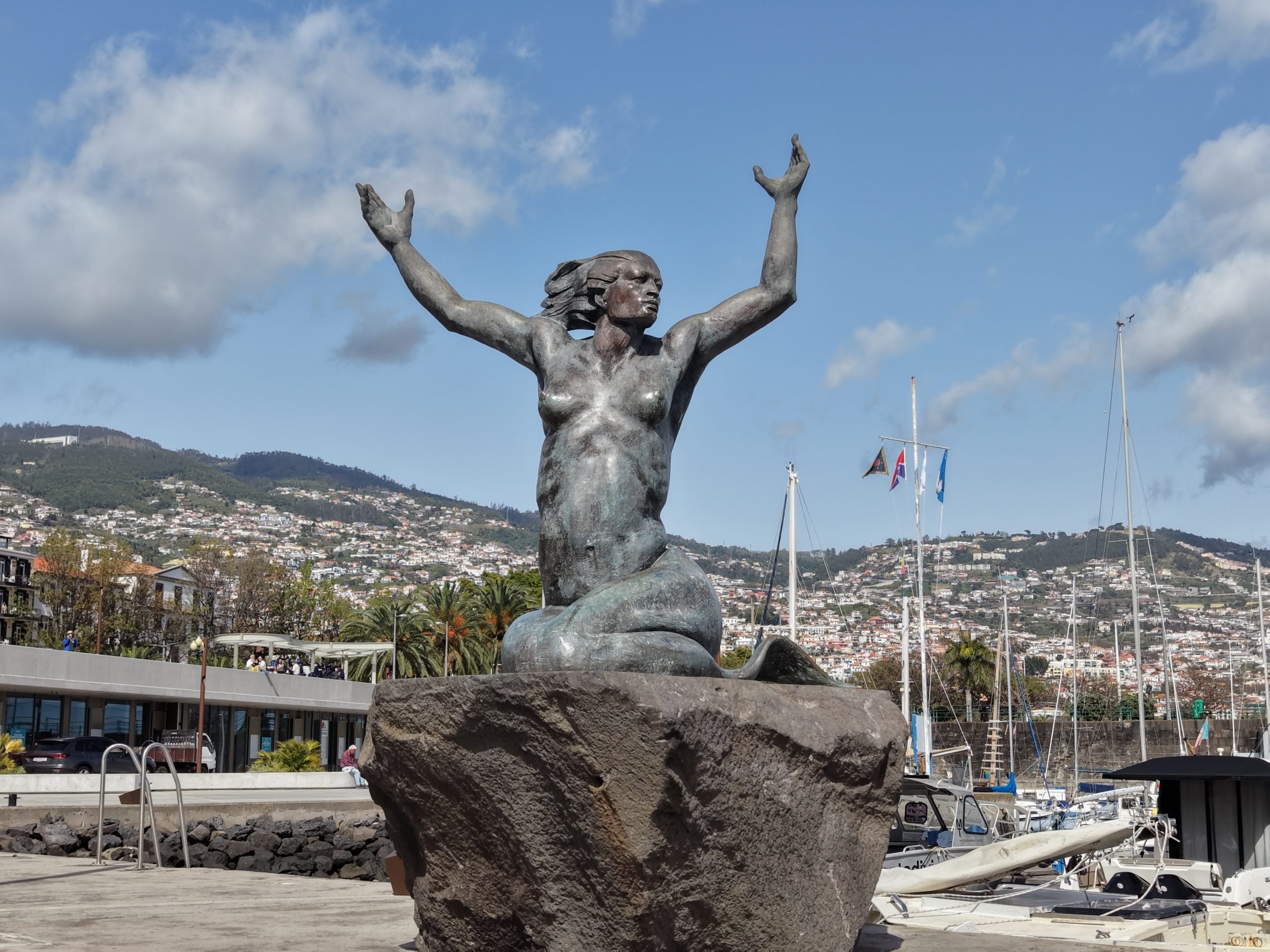
The figure is unlike the quiet, downward-gazing mermaids found in many harbours. Cast in bronze and standing some 235 cm tall, she rises from a coiled, scaled tail with her head turned and her hair streaming back, both arms flung upward toward the sky — a gesture that reads at once as exultation and as a cry toward the open Atlantic. She is mounted on a rough, dark boulder of the island's own volcanic stone, set at the water's edge so that she faces out across the bay. Over the years, passing sailors and visitors have left their marks on the stone base, and the pitted rock has gathered a quiet accretion of scratched names.
The sculptor: Ricardo Velosa
Ricardo Jorge Abrantes Velosa was born in Rio de Janeiro, Brazil and became one of Madeira's most prolific public sculptors. He trained in sculpture at Madeira's fine-arts academy, where he later taught, and went on to serve as the region's Director of Cultural Affairs and to direct the Casa das Mudas arts centre in Calheta. A dedicated medallist as well as a sculptor — the author of more than eighty medals — he also designed the Portuguese five-euro coin honouring Madeira's Laurisilva forest.
His sculptures are found across Madeira and Porto Santo. Among them are a monument to Christopher Columbus (Cristóvão Colombo) on Porto Santo, the Autonomia da Madeira and Monumento ao Trabalhador in Funchal, the figure known as Anjo Caído, and portrait busts of the former Portuguese prime minister Francisco Sá Carneiro and the writer Júlio Dinis. The Sereia at the marina is among his best-known works in the city.
Mermaids in Portuguese and Madeiran lore
In Portuguese the word sereia carries a double meaning, standing for both the fish-tailed mermaid and the classical siren, and in the folklore of a seafaring nation she is no mere ornament. Along the Atlantic coast and in the islands, the mermaid appears again and again in sailors' accounts of the dangers of the deep — a beautiful and perilous presence glimpsed in the swell. Madeira, reached by Portuguese navigators in the fifteenth century and long known as the Pérola do Atlântico, the "Pearl of the Atlantic," has its own store of such sea-legends; one island tale holds that the island was born from a pearl, formed of tears wept over the sea. A mermaid lifting her arms to the sky at the edge of this Atlantic harbour belongs naturally to that older tradition of sea-women who both beckon and warn.
Visiting the Sereia
References:
- Arquipélagos — Heritage record: Sereia, bronze de Ricardo Velosa, 1989, Marina do Funchal — https://www.arquipelagos.pt/imagem/sereia-bronze-de-ricardo-velosa-1989-marina-do-funchal-ilha-da-madeira/
- Ricardo Velosa — Wikipedia — https://en.wikipedia.org/wiki/Ricardo_Velosa
- Brief Notes on Contemporary Public Sculpture in Madeira — Revista Portuguesa de Estudos Artísticos (madeira.gov.pt) — https://rpea.madeira.gov.pt/index.php/rpea/en/article/download/217/181/705
- Sereias in Portuguese folklore — Portugal Num Mapa — https://www.portugalnummapa.com/sereias/
- Madeira: No mito e na lenda — https://correiodevenezuela.com/portugues/madeira-no-mito-e-na-lenda/