Selkies are a variation on the mermaid concept in Scottish, Irish, Icelandic and Faroese folklore. They live in the sea as seals, but can shed their seal hide to become human on land. If their seal skin is hidden or stolen, they are unable to return to the sea.
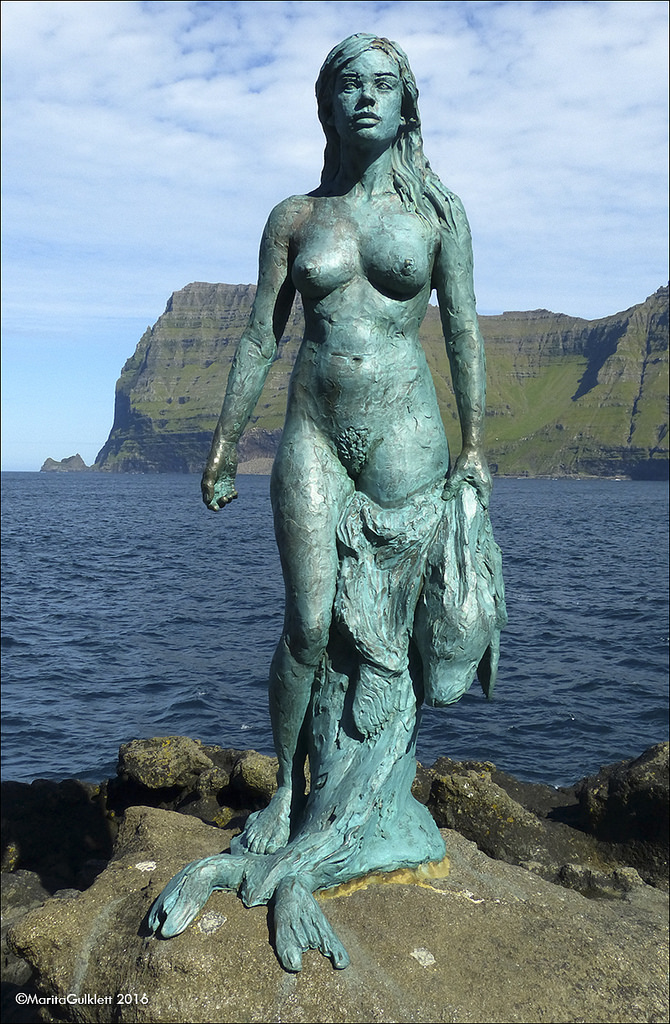
This 9 ft bronze and stainless steel statue of Kópakonan (The Seal Wife) was created by Hans Pauli Olsen and was installed in the Mikladalur Harbor on Kalsoy, one of the Faroe Islands, on August 1st, 2014. map
The Statue
The statue commemorates myths about selkies and in particular a well known myth about the Seal Wife on the Faroe Islands.
Selkie stories are traditionally romantic tragedies, with the Selkie in most stories returning to the sea after several years as a Seal Wife to a human, leaving behind the husband and children.
In the Faroese telling, seals were believed to be the souls of people who had drowned themselves in the sea. Once a year, on Twelfth Night, they were permitted to come ashore, shed their skins, and take human form to dance until dawn. It was on such a night that a young farmer/fisherman from Mikladalur watched a young maiden step out of her seal skin. While she was dancing, he hid the skin.
Trapped, she became his wife and they had 2 children. One day however, he went fishing, but forgot to ensure the chest with the seal skin was locked. She found her seal skin hidden in the chest, and escaped back to her Selkie family, after ensuring her human children are cared for until the fisherman's return.
She left behind a message not to follow her and to not harm her Selkie family. The village fishermen however ignore the warning and end up killing both her Selkie husband and her Selkie children.
In revenge she curses the men of the island to die in frequent accidents until as many have perished as can link arms around the whole island.
Appearing over cooked seal meat, she is said to have cried: "Here lies the head of my husband with his broad nostrils, the hand of Hárek and the foot of Fríðrik. Now there shall be revenge on the men of Mikladalur — and some shall die at sea and others fall from the mountain tops, until there be as many dead as can link hands all round the shores of Kalsoy." Islanders have long held that the toll is not yet complete.
The Sculptor
Kópakonan is the work of Hans Pauli Olsen (born 1957 in Tórshavn), one of the Faroes' best-known sculptors. Trained at the Royal Danish Academy of Fine Arts in Copenhagen between 1979 and 1987, Olsen works chiefly from clay and is celebrated for his treatment of the human figure, with public commissions throughout Tórshavn and a monument to Sigmundur Brestisson at Sandvík.
The figure stands 2.6 metres tall, weighs roughly 450 kilograms, and is cast in bronze over a stainless steel core. Bolted to the rock a few metres above the waterline, it was engineered to withstand North Atlantic waves of up to 13 metres — a design tested in early 2015, when an 11.5-metre wave broke clean over the statue and left it undamaged.
Visiting
Kalsoy is reached by the small car ferry Sam from Klaksvík, a crossing of about twenty minutes. The ferry carries roughly a dozen cars, so in summer many visitors leave the car in Klaksvík and travel on foot. In Mikladalur, follow Bakkavegur down to the coast, past Café Eðge, and take the steps to the shore, where Kópakonan stands bolted to the rocks. The same island served as the setting for the closing scenes of the 2021 James Bond film No Time to Die.
References:
● http://visitkalsoyuk.weebly.com/the-seal-woman-legend.html
● http://old.visitfaroeislands.com/en/be-inspired/in-depth-articles/legend-of-kopakonan-(seal-woman)/
● https://en.wikipedia.org/wiki/Selkie
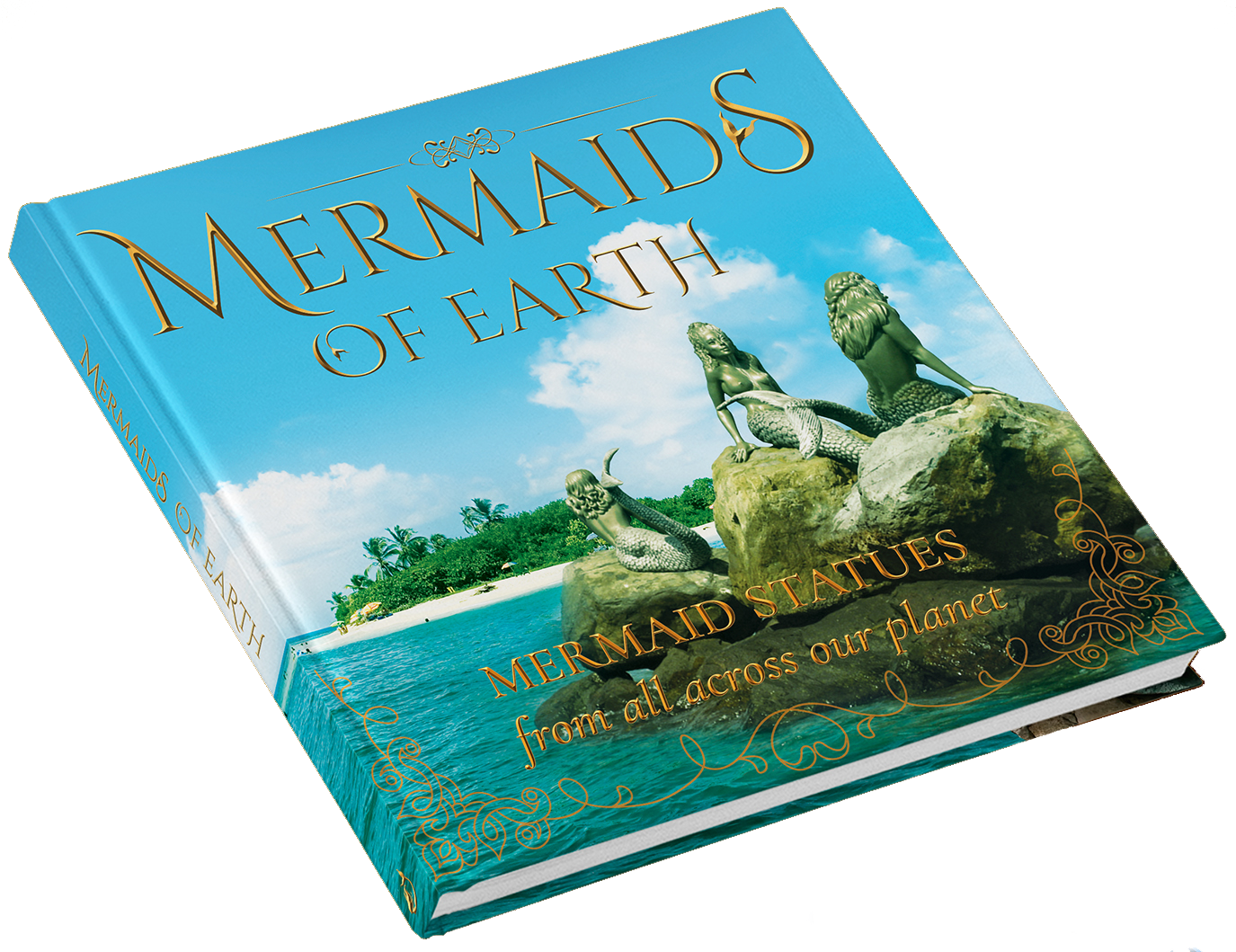
● The Mermaids of Earth coffee-table book: See page 57 in the book about this sculpture.