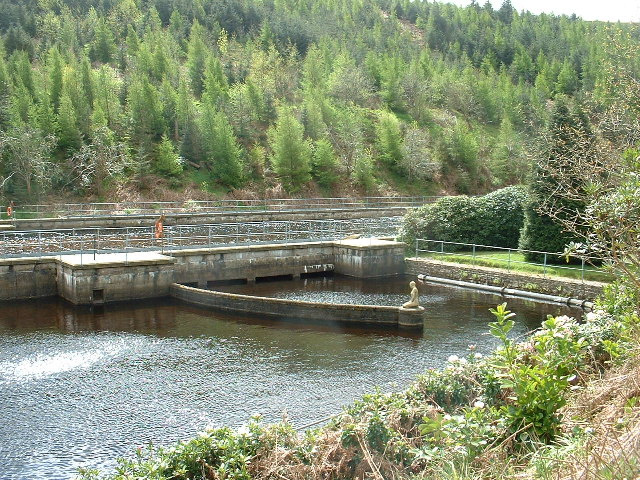
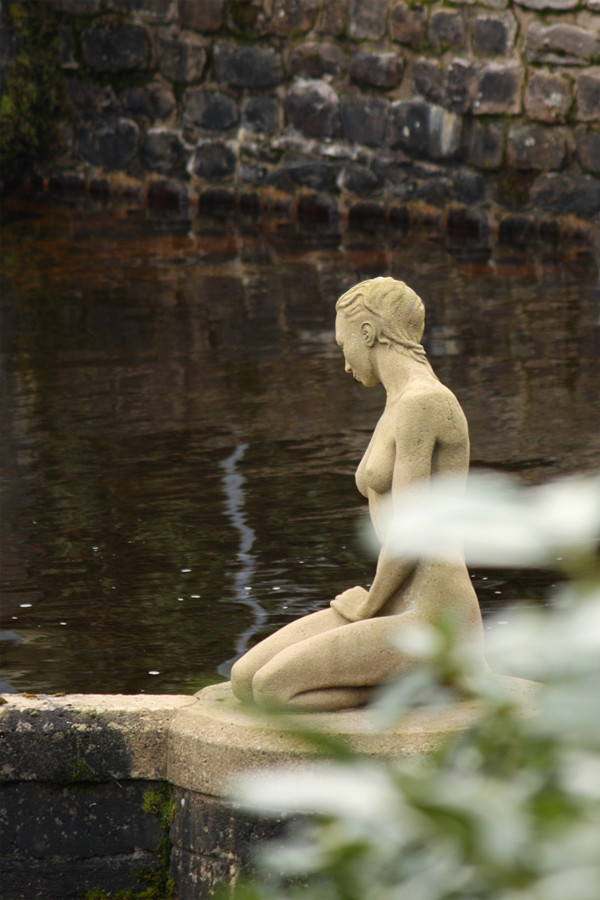
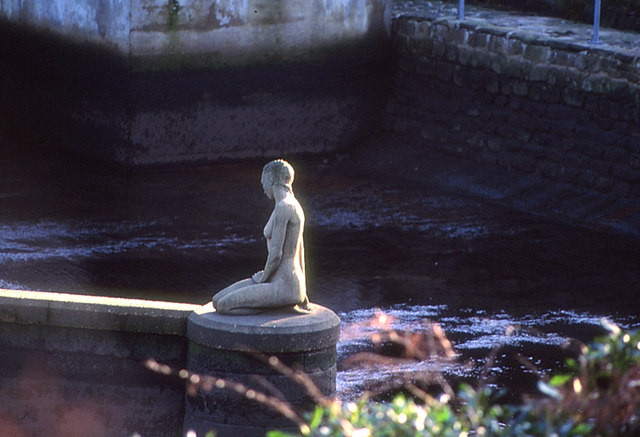
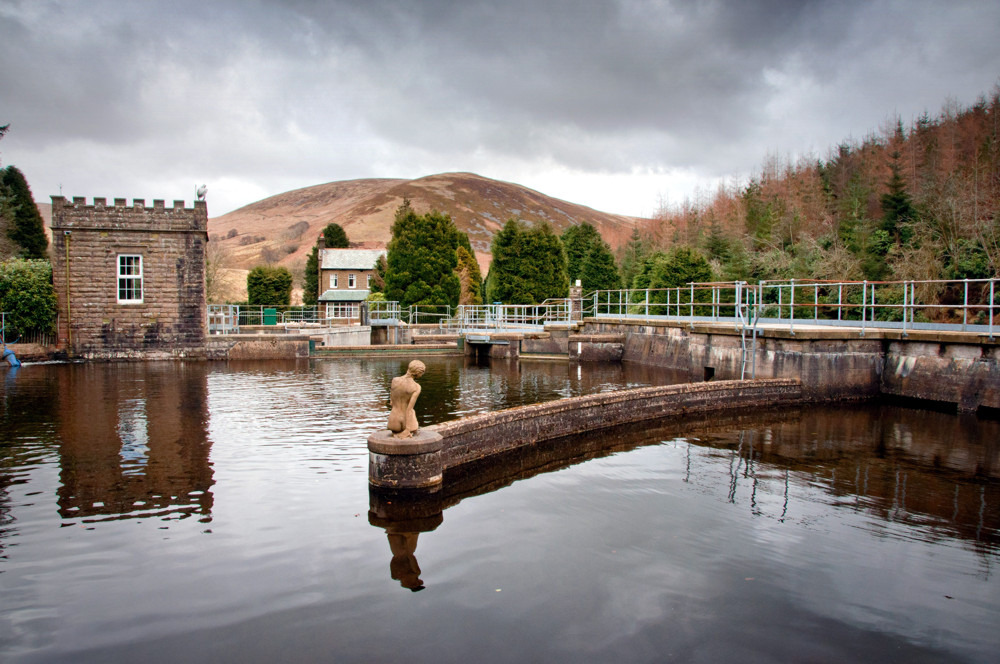
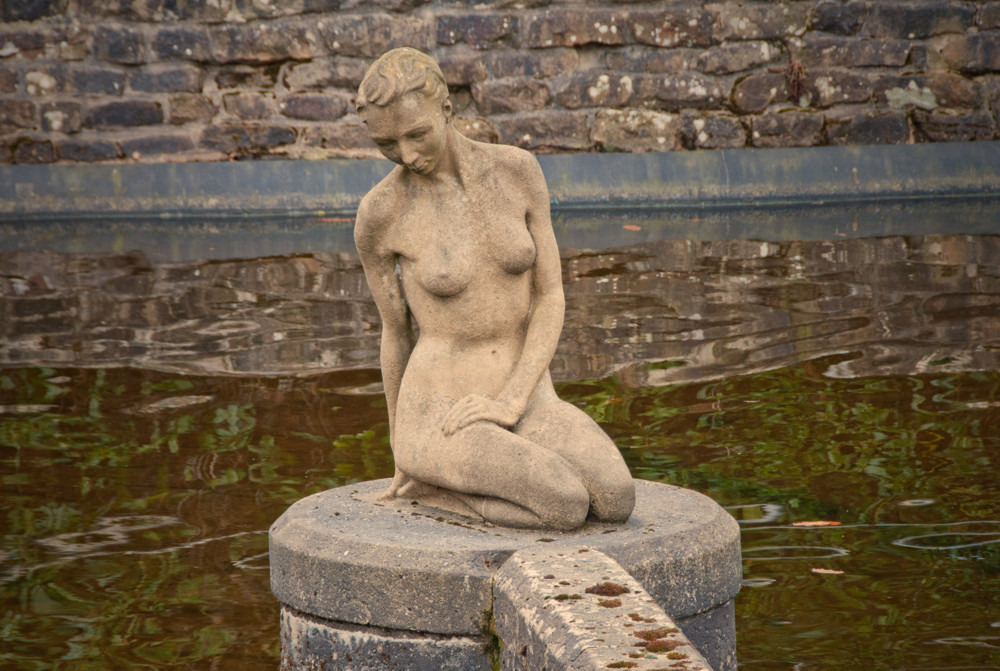
This lovely mermaid statue is located at the Langden Water Intake facility in the Forest of Bowland hills in Lancashire, England.
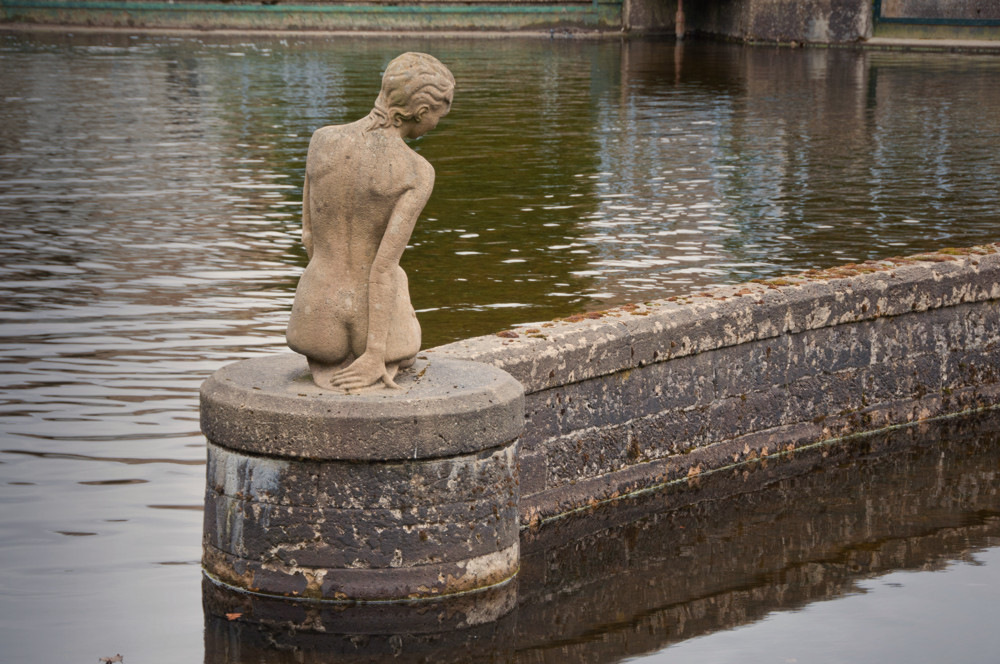
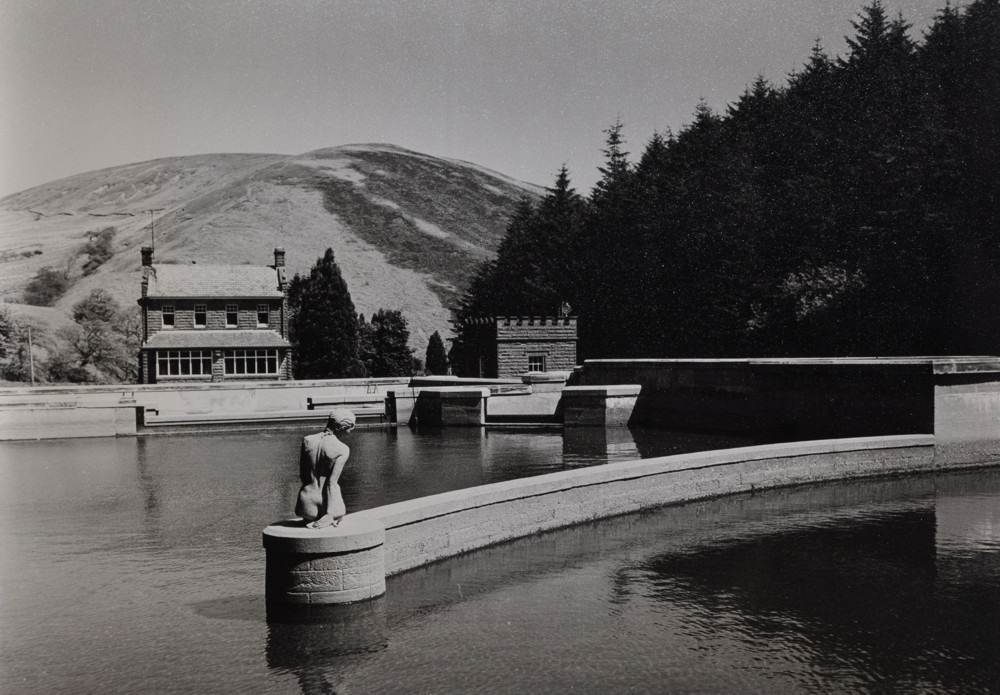
The statue sits on the end of a baffle wall in one of the settling pools, in a smaller lagoon screened from the main path by trees. By 2010 safety railings had been installed around her. map
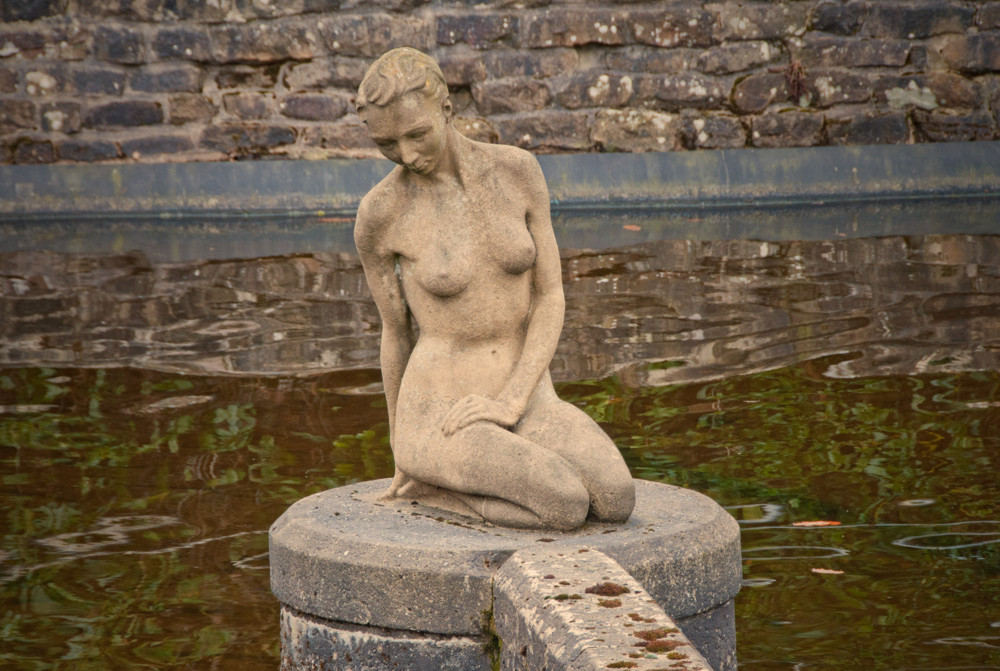
The mermaid sculpture was sculpted in the early 1950's by George Aldersley, an engineer for Preston and District Water Board, and also clearly an accomplished artist.
From Boyd Harris and other colleagues who recall working there with George, the following details have emerged.
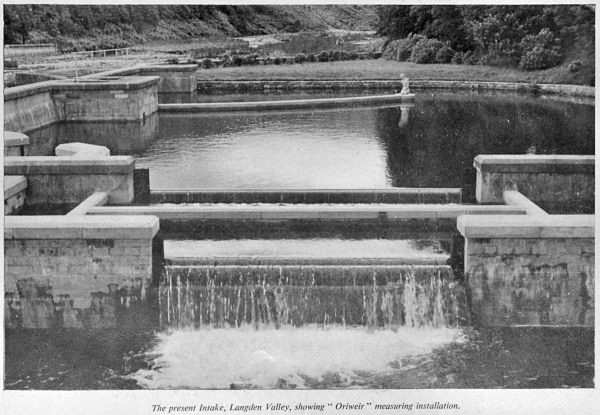
The statue is known as Miranda, and appears in photos in a book by E.C. Oakes published in July of 1953.
The book is E. C. Oakes' history marking one hundred years of public water supply in Preston, published in July 1953. As Aldersley moved to Preston around 1950, the photograph gives a firm latest date and brackets the sculpture to roughly 1950–1953.
Boyd Harris, who worked in the same office, set out the puzzle in December 2012: "George died many years ago and the mystery of the statue's name seemed to have died with him. Colleagues said the model for the statue was George's wife, but she was called Madge, so where did Miranda come from?" Comparison with the 1948 film poster showed the same pose, reversed left to right — the way an artist working from a printed image would naturally flip it. Madge may have sat for the face; the attitude appears to come from the poster.
George pursued the arts in Ambleside (Cumbria) with Madge and their only child Jill after leaving the Water Board in the 1970's. After George passed away, Madge continued her artistic career under the name of Marie Destelle. Jill Aldersley was a well-known and accomplished painter until her death in 2007.
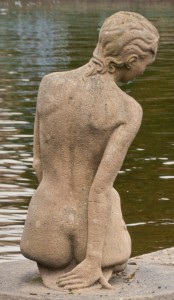
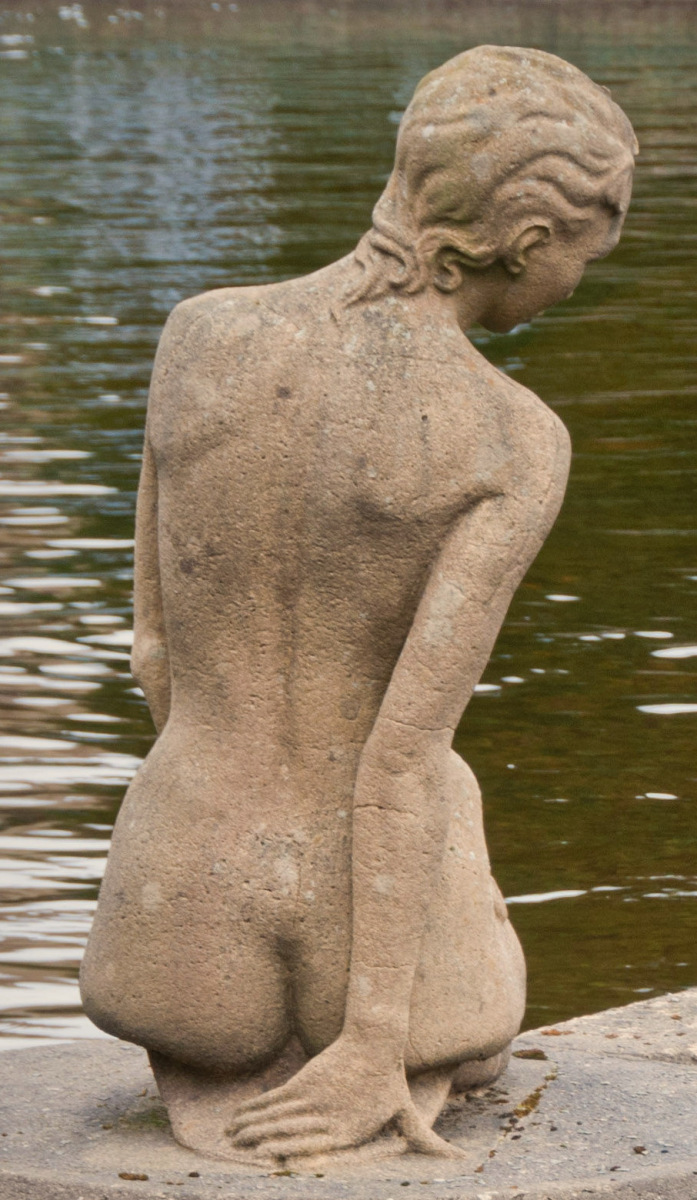
The statue does not have the traditional large mermaid tail, and at first glance may appear to have feet. Closer inspection as seen in this enlarged photo detail shows that the statue's legs end not in feet and toes, but instead are flat and fin-like at the ends, making her a twin-tailed mermaid.
The waterworks
Langden Intake was built in the 1920s, one of three intakes — with Hareden and Losterdale — feeding water by gravity aqueduct from the Bowland fells to the Alston Reservoirs near Longridge and on to Preston. It passed from Preston Corporation Waterworks to Preston and District Water Board, then to North West Water, and is now operated by United Utilities.
Visiting
Langden Intake lies just off the Trough of Bowland road between Dunsop Bridge and Lancaster. Park in the Langden car park beside the brook, cross the blue bridge and follow the tree-lined avenue a few hundred metres into the valley to the cottage and works. The statue is on the wall of a settling pool and can be seen over the gate at the side; she is easily missed, and when the surrounding shrubs are ungrown she is not visible at all. The works are private and fenced with No Entry signs. The track continues about four kilometres up the valley to Langden Castle, a stone shooting hut.
Other twin-tailed mermaids in our collection are listed here.
References:
● http://www.boydharris.co.uk/snap_blog10/snaps1003.htm
● http://www.thewestmorlandgazette.co.uk/news/1802242.ms_j_aldersley/
● http://www.flickr.com/photos/
● The Mermaids of Earth coffee-table book: See page 31 in the book about this sculpture.