A gorgeous statue of Hafmeyjan - icelandic for mermaid - can be found perched on a granite block in lake Tjörnin, located in Hljómskálagarður park, near City Hall in Reykjavik. map
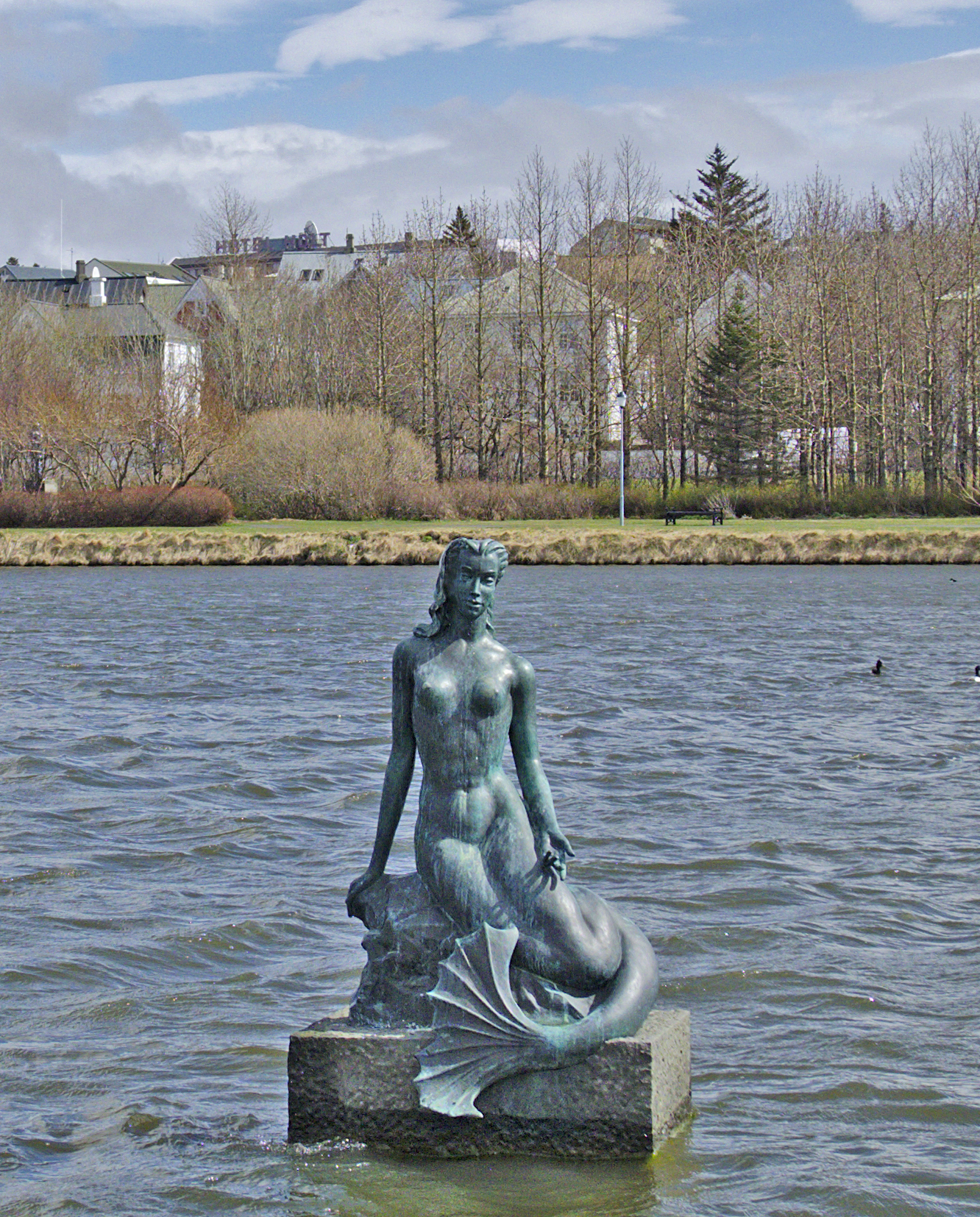
The mermaid statue is by icelandic sculptor Nína Sæmundsson. The statue was originally placed in the lake, then was later moved to a couple different locations in the park near city hall, and was eventually reinstalled in the lake as you see here.
The statue that was blown up
The first bronze was unveiled in Lake Tjörnin in August 1959, on a site suggested by the Icelandic ambassador Thor Thors and chosen with the sculptor's involvement. It was attacked in the Icelandic press almost at once, and figures in the Federation of Icelandic Artists called for its removal. Half an hour after midnight on New Year's night 1960 the statue was destroyed with explosives; police found fragments scattered across the frozen pond. The case was never solved, though a letter claiming the act was published anonymously in the newspapers, giving as its reason that the work was ugly. Nína Sæmundsson did not go to see the wreckage. She died in 1965.
Her return, 2014
In February 2014 Reykjavík City Council approved a sculpture garden beside the Japanese cherry trees at the southwest corner of Hljómskálagarður, honouring six women described by Reykjavík Art Museum director Hafþór Yngvason as the foremothers of Icelandic sculpture: Gunnfríður Jónsdóttir, Nína Sæmundsson, Tove Ólafsson, Þorbjörg Pálsdóttir, Ólöf Pálsdóttir and Gerður Helgadóttir. That June the Smáralind shopping centre presented the city with a new bronze cast from Nína's original mould, received by Jón Gnarr in his final days as mayor, and Hafmeyjan was returned to the water. In November 2017 a storm lifted her from her plinth and she lay on the bed of the pond for several weeks before being raised and reinstalled.
The bronze now in lake Tjörnin was cast from Nína Sæmundsson's original mold, modelled in her Los Angeles studio in the mid-1940s. Sources differ on the year, giving 1944, 1945–47 and 1948.
The Icelandic mermaid
As in many other cultures, there is a myth about a mermaid in Iceland who sits on a rock in the sea and attracts sailors with her song - after which they disappear forever into the depths in her embrace.
But Iceland's oldest written mermaid is not a singer. The margýgr described in Konungs skuggsjá (The King's Mirror), written around 1250, has a large and frightening face, a long sloping forehead and fingers joined by a web, and appears chiefly before violent storms. Sailors read her behaviour as a forecast: if she threw fish toward the ship they feared great loss of life, and if she threw them away from it they hoped to survive the weather.
The Sculptor
Nína Sæmundsson (1892–1965) was born at Nikulásarhús in Fljótshlíð, the youngest of fifteen children, and trained at the Royal Danish Academy of Fine Arts before working in Paris, Italy and, from 1926, the United States. In 1931 she won the competition for Spirit of Achievement above the entrance of the Waldorf Astoria in New York, chosen from roughly 400 entries. Her original model for Hafmeyjan is held privately and is on loan to the municipality of Rangárþing eystra at Hvolsvöllur.
References:
● https://safneign.listasafnreykjavikur.is/is/verk/H-156
● http://icelandreview.com/news/2014/06/14/jon-gnarr-receives-mermaid
● https://www.icelandreview.com/news/jon-gnarr-receives-mermaid/
● https://reykjavik.is/frettir/2014/hoggmyndagardur-til-minningar-um-formaedur-islenskrar-hoggmyndalistar-i-hljomskalagardi
● https://www.hvolsvollur.is/is/frettir/nina-saemundsson-og-hafmeyjan
● https://grapevine.is/news/2017/12/13/the-tjornin-pond-mermaid-hides-underwater/
● The Mermaids of Earth coffee-table book: See page 56 in the book about this sculpture.